
Italy’s industrial hemp sector is showing signs of life after years of contraction, with momentum emerging in food seed and green-building materials, according to a recent analysis.
The shift suggests Italy’s hemp economy may be returning to more traditional industrial markets built around grain and stalk after years of distortion caused by the country’s larger but unstable trade in “cannabis light” (smokable hemp) and CBD.
“Italy has a real opportunity to build strong hemp value chains, but this requires clear rules, institutional dialogue and the courage to treat hemp as an agricultural and industrial resource,” said the author of the analysis, Jacopo Paolini of Enecta, a leading Italian genetics specialist.
Fragmented, stabilizing
Fragmented but gradually stabilizing supply chains for grain and fiber outputs continue to progress, according to the analysis, which combined input from Italy’s Council for Agricultural Research and Analysis of Agricultural Economics (CREA), and agricultural groups and hemp industry associations: Federcanapa, Canapa Sativa Italia, Confagricoltura, and the European Industrial Hemp Association (EIHA).
“The goal should be to finally recognize the full potential of this plant and remove the stigma that has been attached to hemp for far too long,” Paolini said.
Food most resilient
Grain farmed for food appears to be the most resilient part of the market, offering the clearest commercial lane for hemp operators in Italy: lower regulatory risk, identifiable buyers and growing demand tied to broader European interest in plant proteins, specialty oils and functional food ingredients, the report notes.
Demand for edible hemp seed is strengthening, according to the report. Demand is coming from Dutch buyers as well as Italian grain and rice processors, with certified organic in high demand. Growers reported conventional edible hemp seed is trading at roughly €1.80-€2.00/kg, while organic seed reaches about €2.80-€3.00/kg, maintaining a premium of roughly €1/kg.
Paolini said CREA, one of the leading research centers in Europe, is developing a new grain hemp variety, with the objective not only of improving yield, but also increasing the natural content of omega-3, omega-6 and polyphenols already present in the plant.
Building, textiles
Meanwhile, interest in hemp hurds, bast fiber and insulation materials is growing in Central and Northern Italy, where most of the country’s hemp farming and processing infrastructure is concentrated, according to the report. The trend reflects broader European interest in bio-based construction materials, although Italy’s market remains relatively small compared to more developed sectors in France and northern Europe.
The report said the sector still faces familiar constraints, including limited processing scale, fragmented logistics and inconsistent supply volumes.
A working group with leading Italian fashion brands is also exploring the creation of a 100% Made in Italy hemp textile supply chain, according to Paolini. “Italy has a unique textile tradition, and hemp could become a strategic fiber for sustainable fashion if farmers, processors and brands work together,” he said.
Hemp fields lag
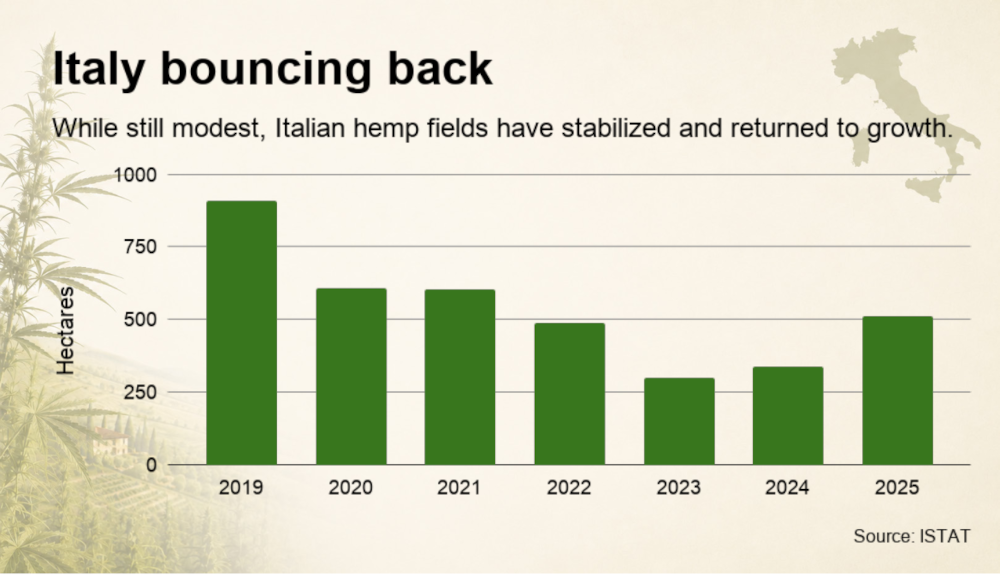
Italy’s hemp hectarage remains far below previous highs, but official data from recent years indicate the decline may have bottomed out.
Confagricoltura cited figures from ISTAT, Italy’s national statistics and economic data agency, that showed cultivated area at 513 hectares in 2025. (Federcanapa estimates the actual planted area may be closer to 250 hectares, suggesting official statistics could overstate active production.) Most hemp cultivation and processing remain concentrated in Northern Italy, where the country’s limited industrial infrastructure is located.
CBD recedes
Cannabinoids and hemp flowers dominated Italy’s hemp economy for much of the past decade, with estimates often placing turnover around €500 million annually and employment near 15,000 jobs. But that market increasingly appears to be entering a long contraction across Europe as regulators tighten food-safety standards and narrow the legal pathway for wellness CBD products.
That shift could help to reduce one of the biggest sources of legal friction around hemp in Italy, where most criminal proceedings and enforcement actions in recent years have centered on flowers, smokable products and retail cannabinoid sales rather than traditional fiber and grain activities.