

Central Europe’s hemp industry should forget about competing with low-cost Asian suppliers in favor of producing premium, traceable textile fiber for European buyers facing stricter sustainability requirements. But Europe’s growing demand for sustainable fibers cannot be met without major investment in processing infrastructure and supply-chain coordination, according to a strategic plan developed by key stakeholders.
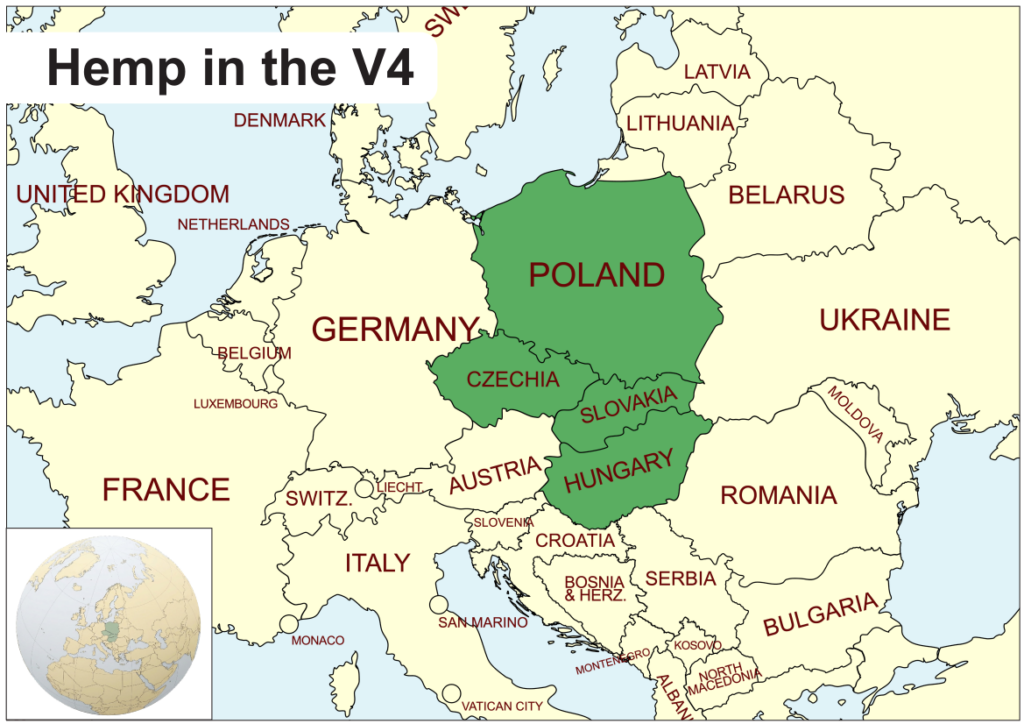
Financed by the International Visegrad Fund, which supports cross-border cooperation in Central Europe, the “Strategic Roadmap for the Revival of Hemp Textile Fibre Production in Central Europe” was developed by a consortium of industry groups and research organizations. It lays out goals through 2035 aimed at restoring textile-grade hemp production across the Visegrad (V4) countries – Czechia, Hungary, Poland and Slovakia – with support from a German partner.
“We see an open window — funding available, buyers curious, and people moving in the same direction across Europe,” said Michal Ruman, manager of CzecHemp, a Czech industry network that is leading the effort. “The roadmap is our attempt to turn that momentum into a functioning value chain.”
Processing gap
The roadmap, released this month, concludes that the biggest bottleneck to hemp textile production lies in the middle of the value chain, where Central Europe lacks sufficient decortication, controlled retting, degumming and fiber-refinement capacity needed to produce such high-grade fibers consistently and at commercial scale.
Project partners argue that downstream textile manufacturers are already positioned to use hemp fibers, but reliable regional supplies remain scarce because processing infrastructure largely disappeared during the past three decades.
The plan identifies controlled retting and advanced fiber processing as the highest investment priorities through 2028. It also calls for anchor purchasing agreements with textile buyers, feasibility studies for new processing facilities, validation of scutching lines in Poland and Czechia, and development of common certification and quality systems.
PL/CZ tandem
The focus on Poland and Czechia reflects where the consortium sees the most immediate chance to prove textile-grade hemp processing under industrial conditions. Poland brings the region’s strongest institutional base through the Institute of Natural Fibres and Medicinal Plants (IWNiRZ), along with relevant processing capacity and technical knowledge.
Czechia combines new domestic decortication investment with CzecHemp’s role as project leader. Testing scutching lines in those two countries would show whether Central European hemp can be cleaned, separated and prepared at the quality and scale needed for spinning, rather than remaining limited to lower-value industrial fiber markets, according to the plan.
Ruman said development of a “green harvest route” combined with a system for bio-retting of fibers is a priority. “This is where investments are going to flow first,” he said.
Market demand
Supporting research conducted during the project suggests demand already exists if reliable supplies can be established.
A survey of 26 companies and organizations across the textile and natural-fiber sectors found that 79% would be interested in sourcing hemp fibers or yarns, while 83% expressed willingness to participate in collaborative initiatives. Sustainability was identified as hemp’s biggest commercial advantage by 88% of respondents.
European sustainability rules include the European Union’s Ecodesign for Sustainable Products Regulation, which is expected to require Digital Product Passports for textiles beginning around 2027, creating stronger incentives for documented local supply chains. The roadmap also points to opportunities created by the EU Bioeconomy Strategy and revised car recycling rules that could expand demand for hemp-based composites.
Barriers to development
Respondents identified several persistent barriers. Price competitiveness ranked as the biggest concern, followed by inconsistent supply, uneven fiber quality and limited processing capacity. Many manufacturers indicated they could incorporate hemp with few production changes if consistent, textile-grade material became available.
The roadmap estimates that hemp yarn imports average roughly €8 per kilogram, compared with about €1.25 per kilogram for raw fiber, illustrating how much value is added through processing — value that currently is captured largely outside Central Europe. It also notes that Germany accounts for 17% of global raw hemp fiber imports, while Italy is the world’s largest importer of hemp yarn by both value and volume.
Step by step
The strategy envisions three phases through 2035, beginning with technical textiles and composites, expanding into automotive applications and apparel, and ultimately targeting medical textiles and premium long-line fibers. It also calls for harmonized quality standards, investment readiness programs, vocational training and a common Central European position in future European Union standardization efforts.
The report focuses primarily on technical feasibility and infrastructure rather than economics. While it identifies missing processing capacity as the industry’s principal constraint, it offers relatively little analysis of whether sufficient private investment, grower participation or long-term customer commitments will emerge to support the proposed facilities. Those commercial questions are likely to determine whether the strategy progresses beyond the planning stage.
“The next five years will show how well we can act together and integrate hemp fibers into the European bioeconomy,” Ruman said.
Roots
Industrial hemp has deep roots in the V4 countries, whose regional partnership dates to 1991, where it was grown for centuries for rope, sailcloth, canvas and other textiles. Under communist governments after World War II, the four countries maintained breeding programs and state-supported hemp production, making the region an important center for fiber genetics and agronomic research.
Much of that infrastructure collapsed after the transition to market economies in the 1990s as low-cost Asian imports displaced European production and textile processing capacity disappeared. While hemp cultivation has gradually returned over the past two decades, most production has supplied seed-based food products and industrial fiber for composites, paper, non-wovens, insulation and other non-textile uses, leaving the region without the integrated processing chain needed to produce high-grade fiber at commercial scale.
Visegrad team
Partners with CzecHemp and Poland’s IWNiRZ on the initiative are the Czech Technology Platform for Textiles (Czechia); the Slovak Hemp Association; Textile Centre Žilina (Slovakia); Kender-Cucc Kft. (Hungary); and Germany’s Natuvalis GmbH.