
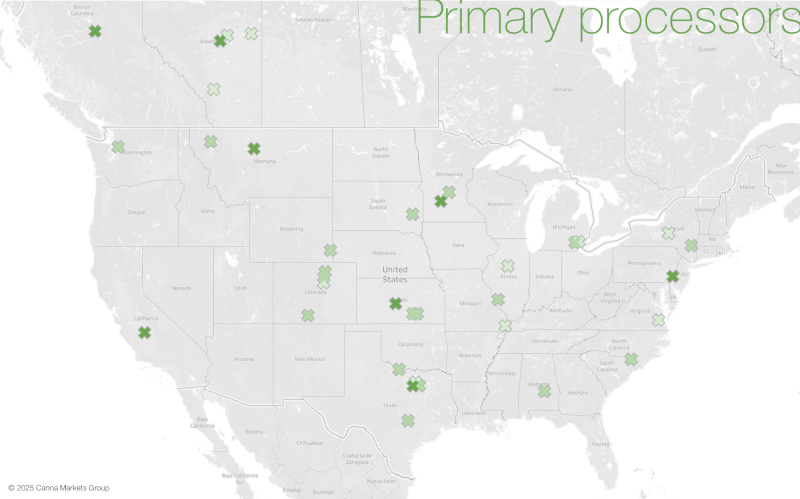
North America’s hemp fiber processing sector remains overwhelmingly optimistic despite facing significant market hurdles, according to a new report jointly released today by Canna Markets Group and HempToday.
The North American Hemp Fiber Processing Report offers one of the most detailed looks yet at the sector’s evolving landscape. Based on surveys, interviews and operational verification across the United States and Canada, the report presents a clear-eyed view of the industry’s current realities—and its path forward.
The first-ever report is being published under the sponsorship of EVOLVE 2033, a strategic initiative led by the Federation of International Hemp Organizations (FIHO). As part of this effort, companies and organizations are invited to sign a formal pledge in support of a comprehensive Market Integration Strategy—a collaborative framework aimed at accelerating the integration of industrial hemp into sustainable agriculture, advanced manufacturing, and global supply chains.
While the report is designed to reflect back at the hemp sector itself, its primary aim is outward-facing: to reach the leaders of industries where hemp shows tremendous potential. It provides a critical look-in for executives in construction, textiles, composites and other sectors where hemp offers climate-aligned, high-performance alternatives to conventional materials.
“Hemp offers sustainable solutions across a number of major industrial sectors. We need to communicate that to the leaders in those industries, and let them know we’re here with our experience and expertise,” said Joseph Carringer, CEO of Canna Markets Group.
Infrastructure gaps
Infrastructure and supply chain development remain critical gaps, and operators must focus on building markets first before scaling production. Although broad reshoring of textile manufacturing appears unlikely, hemp is finding opportunities in specialized, sustainability-driven sectors.
Florida-based Boardwurks Biocomposites is a case in point, Carringer said—an example of the destination industries the report is designed for. The materials innovator needs quality hurd for Hempboard, carbon-smart engineered panels it manufactures that offer a sustainable alternative to particleboard and fiberboard. The company has worked hemp into a broader lineup of natural and recycled marine and building materials made from waste fiberglass laminate used in boat manufacturing and decommissioned wind blades.
“Hemp gives us a low-carbon, U.S.-grown alternative that fits within our existing processes and sustainability goals,” said Miles Gathright, co-founder of Boardwurks. “But we need consistent quality, standardized specs, and a value chain we can count on. This report helps move that conversation forward.”
Industry in transition
While hemp fiber is often heralded as a key material for regenerative construction, textiles, bioplastics and other green innovations, the report finds that the market is still in a fragile, transitional phase. Primary challenges include fragmented infrastructure, inconsistent fiber quality, underdeveloped supply chains and capital constraints.
“What this report makes clear is that despite fragmented infrastructure and market uncertainty, a determined group of stakeholders is actively laying the foundation for a viable hemp fiber economy in North America,” said Joseph Hickey, Director, Communications & Engagement Co-Chair at FIHO.
“That’s a story of resilience—and it deserves recognition. But real progress will only come if we align our efforts. Signing the EVOLVE 2033 pledge is the first step toward building a unified, integrated hemp industry that can meet the challenge,” Hickey added.
The fiber sector’s local-first structure is a strategic advantage, according to Hickey: “Hemp fiber thrives in regional, integrated ecosystems. That makes it less vulnerable to the kind of global trade shocks and supply chain risks we’ve seen in other commodities. In that sense, it’s not just a climate solution—it’s a strategic industrial material.”
The report identifies several key patterns shaping the industry’s future. Expanding fiber hemp production has outpaced demand, leading to market imbalances and price pressures.
Construction, textiles first
The building materials and textile markets are the obvious first points of incursion for hemp materials, according to Carringer, a 20-year veteran in textiles and fashions. “Both are highly polluting industries that need to decarbonize,” he said. “There’s an obvious case for hemp in both sectors that needs to be made to the leaders of those industries.”
The report outlines eight key recommendations, from shifting to demand-led models and building regional ecosystems to developing workforce training and de-risking investment.
“The real opportunity for hemp fiber isn’t about chasing volume or echo-chamber excitement,” Carringer said. “It’s about doing the work—building trust, delivering consistent quality, and showing proof of performance across industries that actually need these materials.”
