
The UK government has awarded $1.2 million in funding for a project aimed at developing hemp varieties tailored to British farming conditions, part of a broader effort to strengthen domestic supply chains for the crop.
The work will focus on developing new hemp strains while reducing farmers’ dependence on imported seed varieties that are often poorly suited to UK climate and regulatory requirements.
British farmers are being invited to participate in trial farms designed to test the varieties across different regions and production systems.
Cutting pathways
The project is supported through the Department for Environment, Food and Rural Affairs’ (Defra) Farming Innovation Programme in partnership with Innovate UK.
Officials say the initiative is intended to help improve crop reliability and yields while supporting clearer commercial pathways as UK demand develops for hemp-based raw materials used in construction materials, food ingredients, bioenergy and other industrial applications.
Local conditions
Many European hemp varieties grow in the UK, but performance varies because the cooler, maritime climate can affect how easily diseases develop, and harvest timing. Also, hemp cultivars respond differently to different daylight periods.
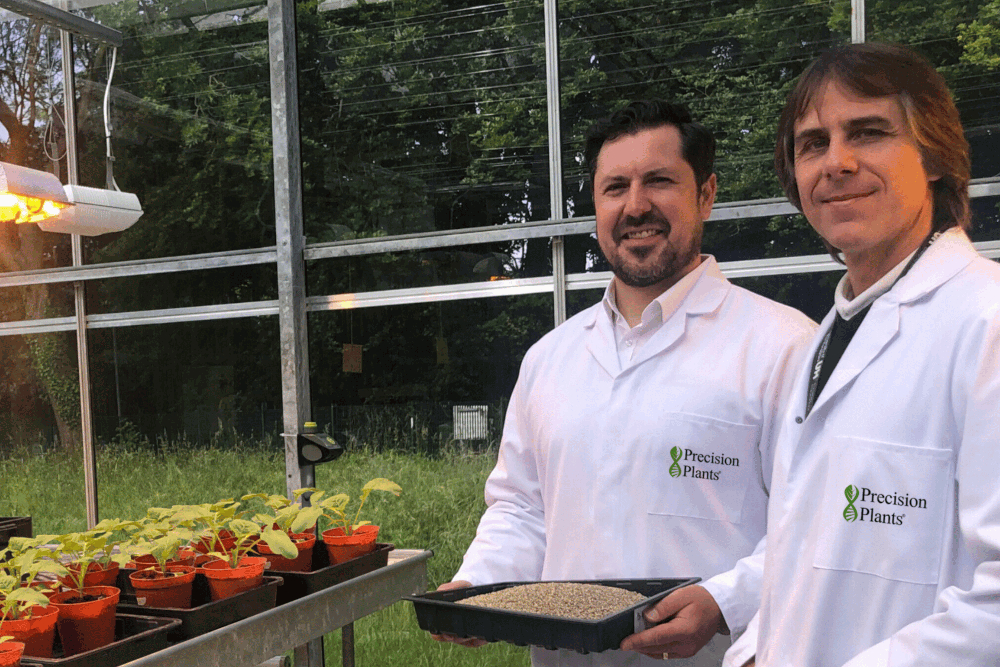
Precision Plants, a UK agri-biotech company, secured £912,000 ($1.2 million) under the Defra program to advance one hemp variety for grain, one for fiber, and one for dual-cropping, from laboratory development through field trials, with hopes of earning listings in the UK’s official register of approved crop varieties.
The company is working with researchers from the University of Hertfordshire and Rothamsted Research on plant genomics, agronomy and field testing needed to prepare the varieties for commercial use.
Farm risks
“This investment supports the creation of a reliable, UK-based hemp seed pipeline that reduces regulatory risk for farmers and improves consistency in the field,” said Charles Clowes, research director and co-founder of Precision Plants.
Risk in hemp is primarily associated with holding down THC levels. Crops over the limit must often be destroyed, which can mean losses for farmers.
The UK operates under a 0.2% THC limit for hemp, a benchmark which harkens back nearly a decade to an old EU rule. The UK government recently accepted advice from the Advisory Council on the Misuse of Drugs to raise the THC limit for hemp from 0.2% to 0.3%, but the change awaits further legislation and parliamentary approval.
The EU, meanwhile, has moved on to a 0.3% THC limit, and stakeholders are pushing to further raise the limit to a full 1.0% THC.
Market context
Farmers who participate in the trials will receive seed and assistance with Home Office hemp licensing requirements. Field data from the trials is expected to inform future commercial rollout if the varieties achieve national listings.
The project is operating within the United Kingdom’s updated precision-breeding regulatory framework, which established a pathway for certain gene-edited crops following national rules introduced in 2025.
UK hemp acreage remains small relative to the country’s arable potential, a situation stakeholders often attribute to regulatory complexity, limited processing infrastructure and restricted access to locally adapted seed.
In a Precision Plants press release, the company noted that Defra has identified hemp as a strategic resource for food, feed, fiber, carbon capture, and fuel. And while recent policy and licensing reforms support expansion to 80,000 hectares of hemp cultivation by 2030, only 136 hemp licenses were in use as of 2023, against a potential 38,000–48,000 farms capable of growing hemp.