
After years of sporadic trials and a small growing area, a first coordinated effort to build a commercial industrial hemp value chain is being promoted in New Brunswick.
The initiative revolves around a planned processing and packaging plant in Saint-André and an organized campaign to recruit growers beginning with the 2026 season, according to Antonio Bramante of Montréal-based Décision de la Nature Inc., who is leading the initiative.
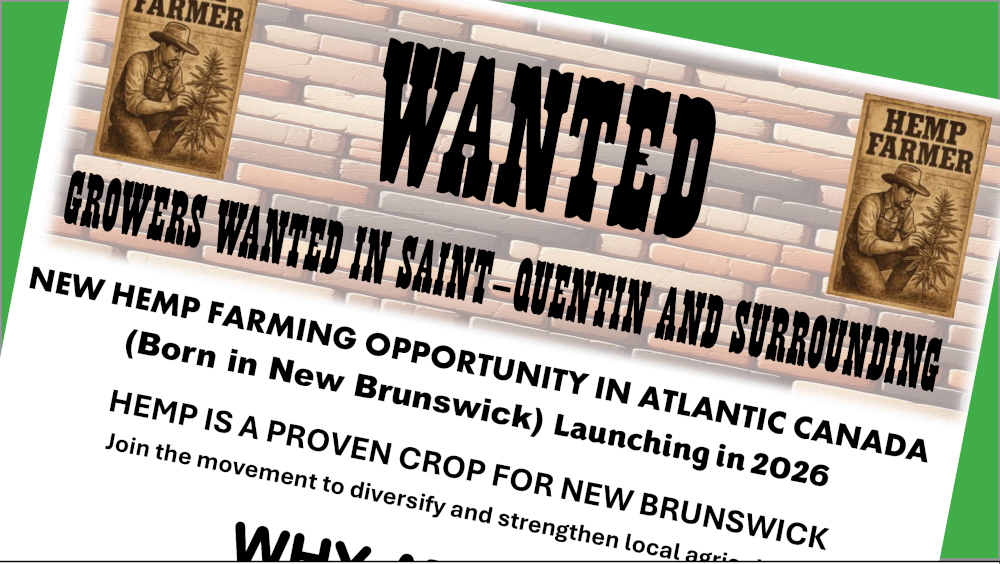
A flyer distributed to farmers described the project as a “new hemp farming opportunity in Atlantic Canada,” inviting growers and regional development stakeholders to learn about licensing, agronomy, and markets.
Goal: 10,000 hectares
Bramante said his team has spent four years meeting producers and provincial officials to build momentum. The plan targets 10,000 acres of hemp in 2026, rising to 25,000 acres in 2027, with part of the crop intended for local processing at the Saint-André facility and the balance going to external buyers. All provinces in Canada grew a combined total 15,000 hectares in 2024.
Organizers say growers will receive hands-on support and argue that the greatest barrier is not agronomics, but farmer hesitation: shifting to a new crop, new markets, and unfamiliar logistics. The strategy positions hemp as a rotation crop that can diversify farm revenues while building toward regional food, fiber, and biomass markets.
Whether hemp can scale in New Brunswick will depend on its fit within existing agricultural systems. Northern and western New Brunswick contain several distinct farming zones that shape the opportunity.
Fertile fields
In the Woodstock–Drummond corridor, where grower outreach is concentrated, farms use deep, well-drained soils and rotate their acres through potatoes, grains, and forage crops.
Further north, toward St-Quentin, fields sit at higher elevation with cooler temperatures, supporting grains, forages, and mixed farm-forestry operations. The Belledune area, by contrast, has more variable soils and historically less intensive cropping activity.
Hemp could integrate into these rotations — particularly in the Woodstock–Drummond zone — but success will depend on agronomy, variety selection, and timing within a shorter growing season than Canada’s Prairies — where most hemp is grown in the country.
The scale of the vision stands in contrast to the province’s track record. Government data show 203 hectares of hemp in 2017, rising to ~448 hectares in 2018, with yields described as inconsistent. More recent federal licensing figures suggest activity has dwindled to a few hectares since.