

In the lingering battle over intoxicating hemp in the U.S., a newly formed “coalition” has entered the debate — an engineered, campaign-style effort that presents itself as grassroots while operating through Washington insiders.
Hemp Industry and Farmers of America (HIFA), which “emerged” (as its website observes) last December, is linked to both Republican and Democrat lobbyists, and is rather obviously a shill for intoxicating hemp producers and their CBD-making handmaidens.
Press reports have identified Brian Swensen, a political strategist who served as national political director for FBI Director Vivek Ramaswamy’s failed 2024 presidential bid before switching to the Trump campaign, as the group’s executive director. He was also previously deputy campaign manager for Marco Rubio’s 2016 Senate campaign.
I mean, look: If you’re gonna deal with a criminal organization, you need a good interface, right?
‘Bi-partisan’
In this particular case, HIFA has also reached into the Democrat swamp to retain former Kentucky Secretary of State Bob Babbage as its registered federal lobbyist. Babbage is the founder of Lexington-based Babbage Cofounder, which has been retained to represent HIFA in Washington.
HIFA claims to have “participated in substantive meetings with White House officials to discuss pathways forward for hemp that balance regulatory concerns, public safety, and economic realities.”
Most recently, the lobbyists launched an effort to advance the so-called Baird-Craig extension, which would extend a December deadline by three years before rules eliminating intoxicating hemp products take effect.
Lobbying disclosures show that HIFA has so far spent tens of thousands of dollars focused on agriculture policy and preservation of hemp-related provisions in federal law. Federal Election Commission filings show that the organization reported roughly $189,961 in receipts for February 2026. The contributions are a mix of small-dollar donations and larger inputs tied to hemp and cannabis-related businesses. The group solicits donations starting at $100.
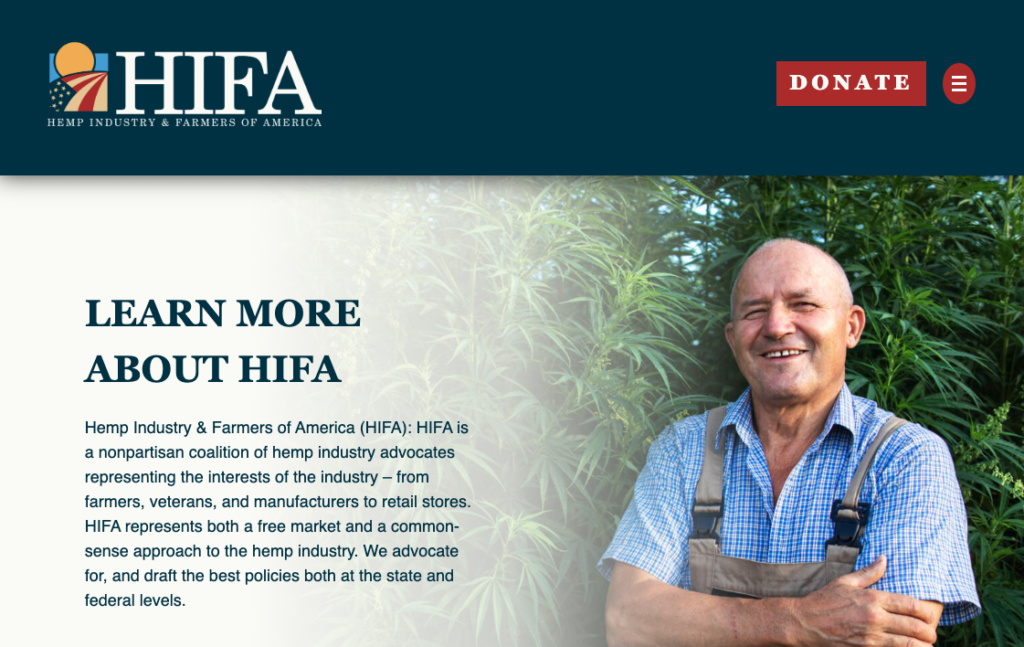
What’s that Serbian agronomist doing in Amerika?
Helping ‘farmers’
As the U.S. regulatory door is closing on intoxicating hemp, HIFA is here on behalf of beleaguered “hemp farmers” (why do they always hide behind the farmers?) while actually working to advance the interests of a cabal of desperate CBD companies and the dodgy producers of those downstream THC treats the kids can get down at the convenience store.
To remind you, the U.S. federal government has already moved decisively against synthetic hemp intoxicants. The 2025 funding law signed by Trump last December redefined hemp, removing delta-8, HHC, THCA flower and any similar compounds from the category. That action closed the loophole that allowed chemically altered cannabinoids to proliferate under the guise of agriculture.
What remains is not a policy debate so much as a rear-guard action. The intoxicating hemp sector — built on regulatory ambiguity and, well, clever chemistry — is now confronting its endgame. But it has always rested on a fragile premise — that Congress would indefinitely tolerate a market in psychoactive products derived from hemp, sold outside the regulatory frameworks governing cannabis – a market that was never intended. They’ll likely be proven wrong. We hope so.
The damage done
For much of the past five years, intoxicating hemp dominated the narrative around the crop. It diverted attention from fiber, grain, and industrial applications — the sectors that underpin hemp’s long-term economic case.
Instead of investment in processing infrastructure, materials science, and agricultural systems, the conversation was consumed by products sold in vape shops and convenience stores. That distortion carried real consequences. It blurred the identity of hemp as an agricultural commodity. It complicated policy discussions. And it gave critics an easy target.
Now, as the legal framework tightens, the sector that drove that distortion frames itself as the voice of farmers and the broader industry. The effect is less persuasive than it might once have been. At this stage, it’s exploitative and sad.
But will it work? In today’s Washington, with the right connections, one never knows what will happen.