
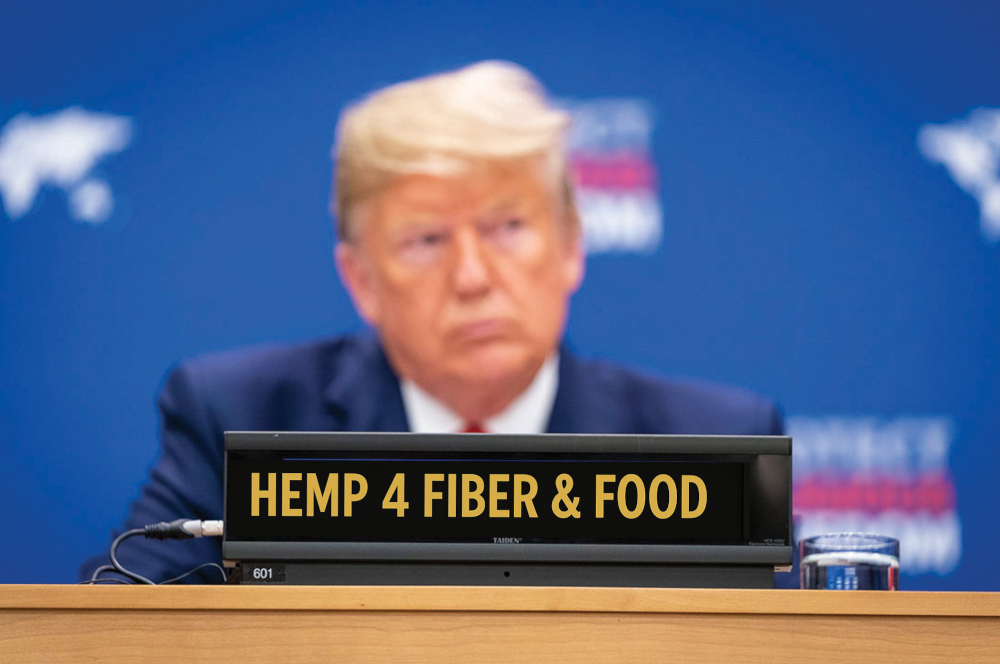
With the stroke of his famous Sharpie, U.S. President Donald Trump has ended one of the wildest chapters in hemp history. A provision in the government funding law he signed yesterday outlaws products containing intoxicating hemp substances — delta-8, THCA flower, HHC, THC-P and other lab-made variants — shutting down a multibillion-dollar gray market that thrived for half a decade under a loophole in earlier legislation.
The trade that regretably blurred the line between hemp and marijuana — and flooded the nation’s vape shops and convenience stores with unregulated synthetic intoxicants — is now illegal based on a re-definition of hemp in the law. Overnight, the dodgy producers and retailers of drinks, gummies and other snacks laced with the substances clearly have no legal ground left to stand on.
For Trump, it was the second big favor he has done for the hemp industry, after he happened to be sitting in the Oval Office when the 2018 Farm Bill crossed his desk during his first term. Unfortunately, the hemp provisions in that landmark legislation, which legalized hemp and any downstream outputs, failed to envision the possibility that intoxicating substances could be made from hemp-derived CBD. That loophole gave rise to the nationwide intoxicating-hemp frenzy.
Disruption, and then some
The scale of disruption should not be understated: a sector reportedly worth more than $10 billion that employs some 300,000 workers will go out of business. The re-definition of hemp and regulatory squeeze will have ripple effects across farming, manufacturing, retail, consumer access and state regulatory regimes.
A provision in the law mandates that within one year of enactment the “total THC” — including delta-8 and other isomers as well as “any other cannabinoids that have similar effects (or are marketed to have similar effects)… as a tetrahydrocannabinol” — will determine whether a product qualifies as legal hemp.
Stakeholders face exposure from stranded inventory, lingering regulatory uncertainty, limits on banking services, and potential legal liability for mislabelling or mis-marketing products that are now federally illicit. In the near term, they can expect federal agencies and state regulators to begin coordinated enforcement sweeps, product seizures, and warning letters even before the one-year implementation window closes.
A sharper definition
Specifically, the law bans any hemp-derived cannabinoid products sold directly to consumers for personal or household use, as well as any cannabinoids made synthetically rather than naturally by the plant.
The redefinition effectively returns hemp to what Congress originally intended in 2018: a crop grown for fiber, grain, and non-intoxicating seed derivatives. By shifting from a narrow delta-9 THC standard to a “total THC” test and excluding any cannabinoids that are synthesized, converted, or not naturally produced by the plant, the law places delta-8, HHC, THCA flower, THC-P, and similar intoxicating substances outside the legal definition of hemp altogether. Once excluded, these products no longer fall under USDA’s hemp framework and are instead expected to be treated as controlled substances.
The new hemp definition and related prohibitions become fully effective on November 12, 2026.
Within 90 days, the U.S. Food and Drug Administration (FDA) and other agencies must release lists identifying which cannabinoids occur naturally in Cannabis sativa L. (industrial hemp), which belong to the THC family, and which have — or are marketed to have — THC-like effects.
Stakeholders could mount legal challenges to the ban, but are unlikely to find success because Congress has broad authority to define “hemp,” regulate interstate commerce, and restrict synthetic or intoxicating cannabinoids on public-health grounds, and courts rarely overturn such statutory changes. While lawsuits may delay certain provisions or enforcement timelines, the core prohibition is almost certain to withstand judicial scrutiny.