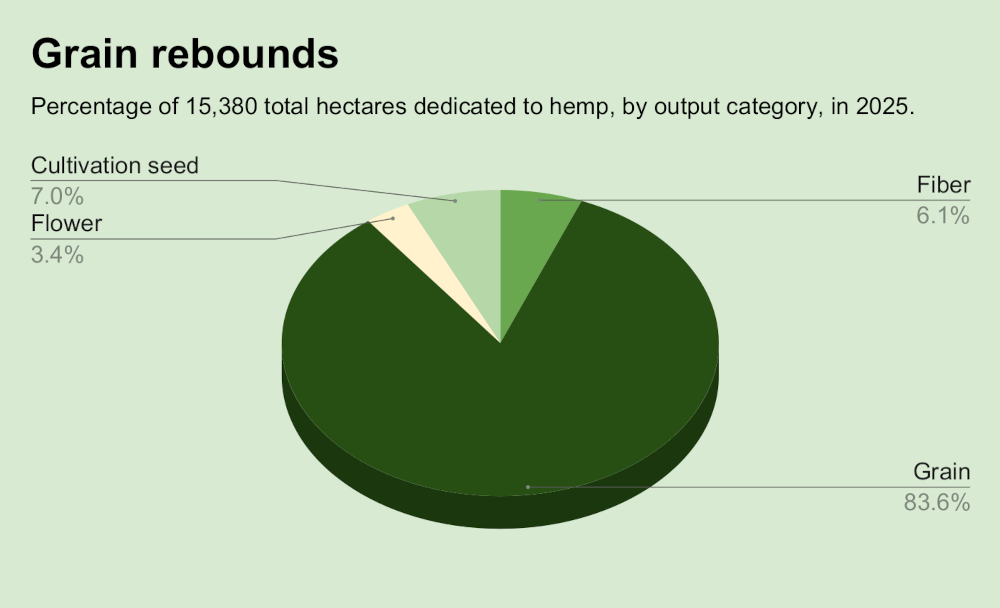
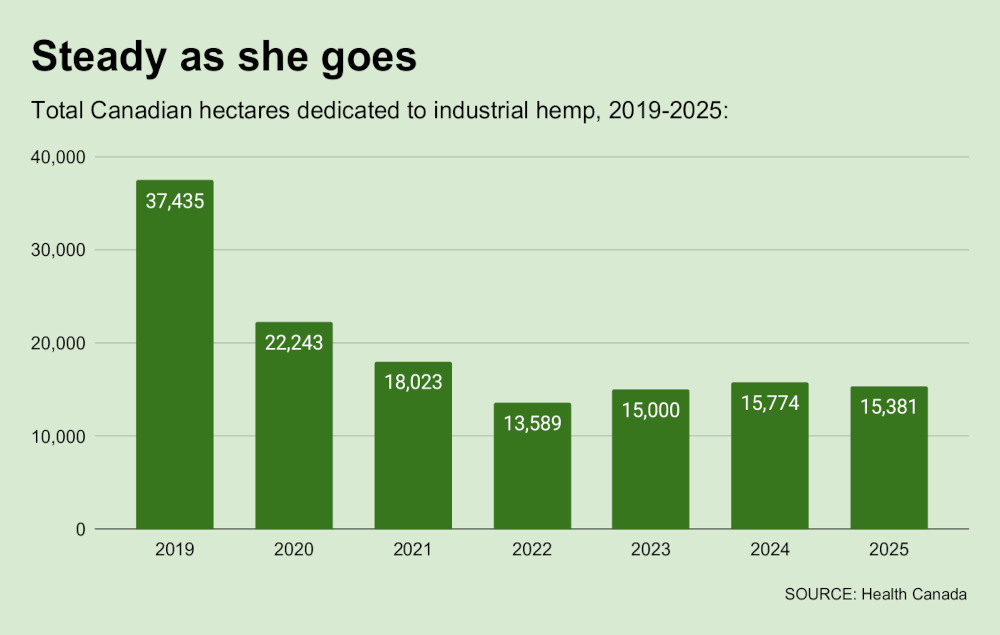
Canadian fields cultivated for hemp grain rebounded sharply as overall hemp acreage remained relatively stable in 2025, according to the latest annual statistics from the government.
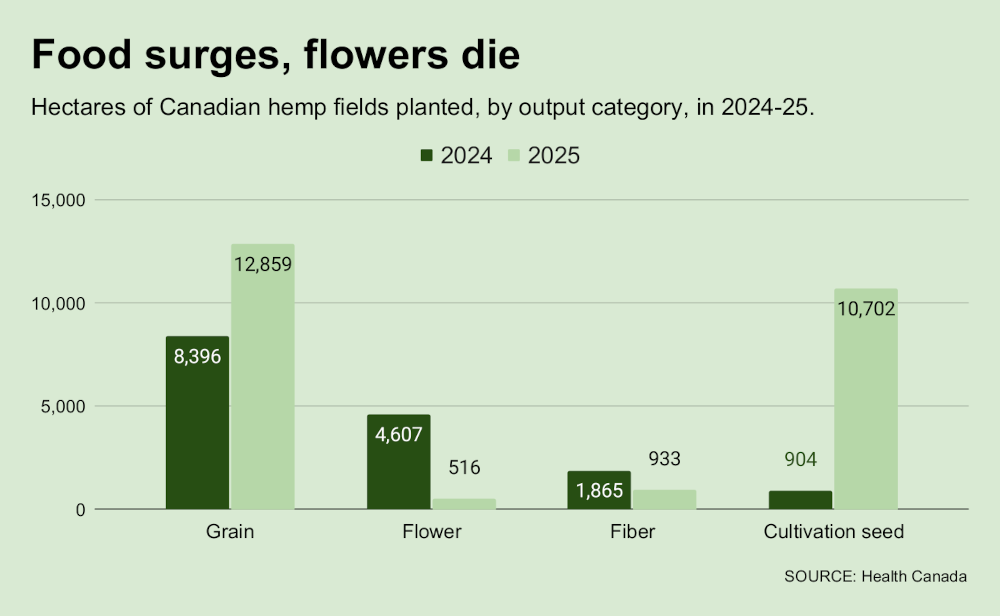
Grain, which has historically formed the backbone of Canada’s hemp industry, jumped 53% to 12,859 hectares from roughly 8,400 in 2024, Health Canada, the government health agency, reported. Grain accounted for more than 80% of all reported hemp fields in 2025.
The increase appears to support observations last year that grain demand was strengthening after shortages emerged in the market. Canadian suppliers have longstanding markets for hempseed foods – primarily in the USA because American hemp farmers grow little food seed – while lower-grade or surplus grain has found a fallback market in European birdseed.
Growers reported 15,380 total hemp hectares planted in 2025, down just 2.5% from 15,774 hectares a year earlier. But the mix of crops changed dramatically.
Flower retreats
Canada’s brief hemp flower boom evaporated in 2025 as fields devoted to CBD and other cannabinoids all but disappeared, with just 516 hectares, compared to about 4,600 in 2024, when fields had nearly quintupled amid expectations that Canada might eventually open a broader market for over-the-counter CBD products. Mainly hit was Quebec, where growers planted 3,629 hectares for flower in 2024, but just 42 hectares last year.
CBD remains tightly controlled in Canada under the federal Cannabis Act, which generally restricts cannabinoid products to the regulated cannabis system. The government has considered creating a pathway for some CBD products to be sold outside cannabis dispensaries, but no such market has yet opened. However, global sentiment regarding CBD has cooled. European regulators effectively pushed much of the ingestible CBD market out of existence, most recently by setting a provisional safe intake level of just 2 mg per day.
Fiber falls again
Fiber production also continued to retreat in Canada. Fields planted for fiber fell by half, to 933 hectares from 1,865 in 2024. That followed a decline of nearly 50% the previous year, when fiber acreage dropped from 3,260 hectares in 2023.
The two-year slide leaves Canadian fiber cultivation at less than one-third its 2023 level, despite growing international interest in hemp for construction materials, biocomposites, textiles and other industrial applications.
Cultivation seed accounted for another 1,072 hectares in 2025.
Western base
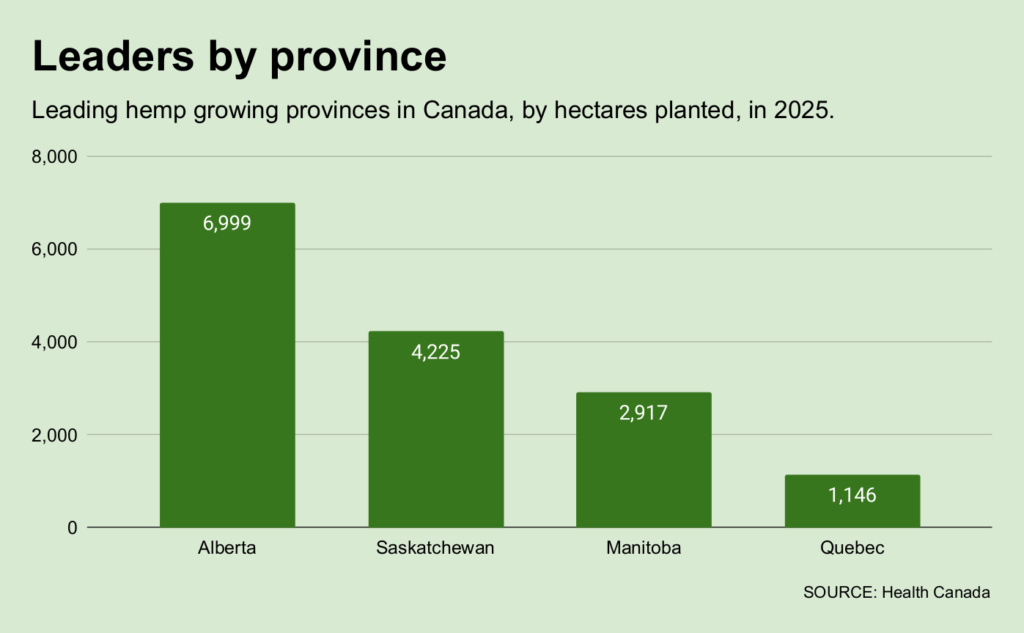
Canada’s hemp crop remains overwhelmingly concentrated in the Prairie provinces. Alberta led the country with 6,999 hectares in 2025, followed by Saskatchewan with 4,225 and Manitoba with 2,917. Together, the three provinces accounted for roughly 92% of reported cultivation.
Finola, a Finnish variety, remained by far the dominant cultivar, planted on 8,955 hectares, or roughly 58% of all Canadian hemp fields. Canadian cultivar Rak ranked second at 4,456 hectares.Licenses decline
The number of active industrial hemp licenses also continued to fall, dropping to 585 at the end of 2025 from 624 a year earlier. Canada had 1,269 active hemp licenses at the sector’s recent peak in 2020.