
Update and clarification: This story has been updated to reflect terminology used in Chinese commodity reporting, where fibers labeled as “hemp” may be classified within broader bast-fiber categories. This resulted in previously reported figures that likely overstated hemp imports specifically.
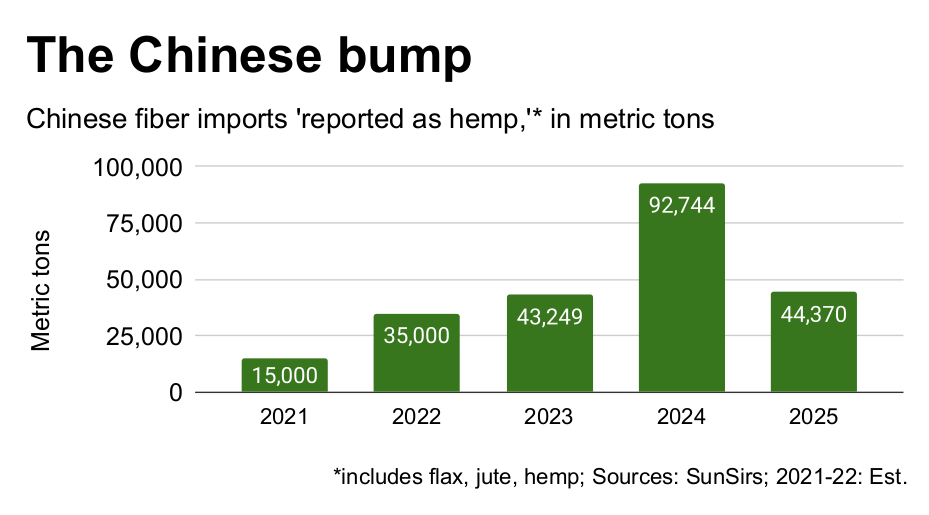
China’s imports of fiber reported as “hemp” were cut in half in 2025 after a steep rise over the previous few years, signaling some volatility in the world’s most important market for bast fibers used in textile production.
According to Chinese customs figures, the country imported 44,370 metric tons of such fibers in 2025, down from 92,744 tons in 2024, a decline of 52.16%.
The figures are reported as “hemp” in Chinese commodity data, but they sit within a broader bast-fiber system that includes flax, jute and other plant fibers that are often substituted or blended in textile production. As a result, they should be read as indicative rather than a precise measure of hemp-specific imports.
Because the category includes overlapping bast fibers, the decline may reflect substitution effects — with hemp potentially losing share to competing materials such as flax — rather than a purely hemp-specific contraction. Isolated figures for hemp do not seem to be reported, but SunSirs, a Chinese analyst that tracks commodities, attributed the drop to “the significant increase in the planting area of (industrial) hemp in Northeast China in 2024,” which boosted domestic raw-material availability for 2025.
Demand shift
The drop matters because China is the market-moving buyer of bast fibers used in spinning, blended yarns and textile conversion. Publicly cited trade figures indicate the grouping of imports led by flax, hemp and jute, rose from just 837 tons in 2020 to tens of thousands of tons by 2023–2025, as Chinese mills leaned more heavily on imported supply to complement domestic production.
The sharp reversal now points to a market that can change quickly depending on domestic acreage, competing fibers and downstream textile demand, the analyst said.
France leads
Despite the downturn, the figures suggest France has strengthened its position as the main European gateway into China’s overall natural-fiber market, with French producers supplying 74.29% of China’s imports in 2025, up from 63.66% in 2024. Belgium, the next largest single importer to China, fell to 3.26% from 19.73% a year earlier. Other main suppliers over the past two years were Russia, Netherlands and Ukraine. Those figures primarily represent flax imports, but include hemp, jute and other minor fibers.
As far back as 2020, China agreed to purchase an unspecified amount of hemp fiber from the United States as part of a total $12.5 billion agriculture trade deal, but there is little to indicate any trade took place as U.S. producers were simply not set up to produce any significant volume.
Export side
Even as fiber imports fell last year, China remains the world’s biggest exporter of textile products classified as hemp — a category that includes large volumes of flax and blended materials — with more than 3,500 tons of yarn and over 16 million meters of fabric shipped abroad. Fibers, yarns, fabrics and finished goods totaled $2.018 billion in 2025, down 15.23% from 2024, SunSirs said.
Exports reached nearly 200 countries, with major markets across Asia and in Italy, Spain, Turkey and the United States.
Exports to the United States rose 1.75% year over year, though no bilateral dollar value was reported. “In the face of such a changeable U.S. tariff policy, the growth of exports to the United States still reflects the rigid demand for (natural fiber) textile products in the U.S. market to some extent,” SunSirs said.
Among shipments to the U.S., fabrics accounted for 33.19% and finished products 66.81%.