
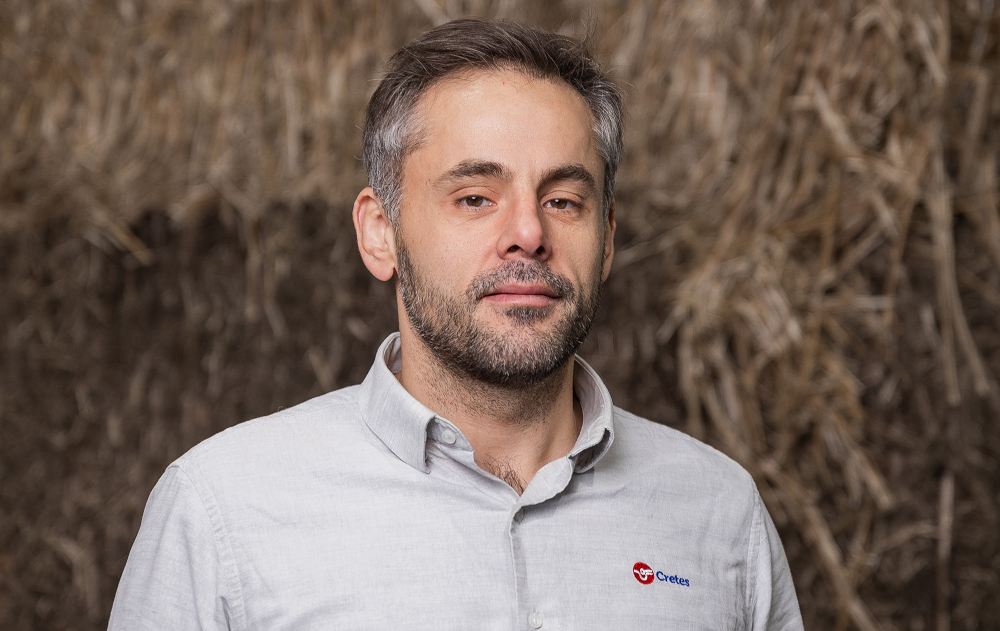
INTERVIEW: Alex Teodorescu leads the commercial development of natural fiber processing systems at Cretes (CREative TEchnical Solutions). Drawing on more than 15 years of experience in machine building, he brings together expertise in industrial engineering and bast fiber processing. Since joining the Belgium-based company in 2022, he has focused on developing and delivering tailored processing solutions for hemp and other bast fibers, helping bridge pilot-scale trials with industrial production.
HempToday: Cretes positions itself as a bridge between flax and hemp. How transferable is flax processing know-how to hemp in practice?
Alex Teodorescu: A large part of flax-processing know-how is indeed transferable to hemp. At its core, bast fiber processing relies on the same fundamental principles—mechanical separation of fibers, cleaning of fibers and shives, and controlled baling—principles that are the result of decades of flax processing.
That said, hemp is not flax, and it cannot be approached as a simple copy-paste of existing solutions. Historically, flax has been processed mainly through scutching technology, whereas hemp has more often relied on multi-stage decortication systems. These differences stem from both agronomic practices and historical end markets.

Meet Alex Teodorescu at this year’s EIHA Conference Session:
Machinery & Processing: Scaling Industrial Capacity
June 11-12, 2026 | Poznań, Poland.
Since 2020, with the invention of parallel hemp harvesting and dedicated trials carried out by Cretes, it has become possible to process hemp using technology derived from flax scutching. This evolution has helped bridge the historical gap between the two fibers.
While each fiber retains its own characteristics, the underlying processing technologies are far more connected than many people assume today.
HT: Where do hemp fibers still fail to meet the consistency required by textile-grade processing?
AT: From our experience, the question is not whether hemp can reach textile-grade quality. It can. We have seen that repeatedly. The real challenge lies in consistency.
Textile-grade processing does not depend on a few successful trials or isolated high-quality batches. It requires repeatability—batch after batch, day after day, at an industrial scale. Without that consistency, it becomes extremely difficult to build a reliable textile value chain.
At the same time, it is important not to view hemp solely through a textile lens. Hemp is far more than a textile fiber. It is a highly versatile raw material with strong potential in construction materials, composites, nonwovens, paper, and other technical applications. Anyone entering this sector needs to understand that the real opportunity is broader, and that successful projects often balance multiple markets rather than relying on textiles alone.
HT: You offer batch production testing. What are customers typically surprised by when they run their material through your system?
AT: We opened our production testing facility in Wielsbeke (Belgium) in 2023 with a very clear objective: to give customers a realistic and factual basis for decision-making. Our goal is not to make promises on paper, but to demonstrate, under real processing conditions, which line configuration fits their raw material and target applications best.
That is the real value of production testing. By running batches of a few hundred kilos, customers can move away from assumptions and toward facts. Instead of theoretical discussions about yields or performance, they can observe directly how their own material behaves throughout the process, and where its real opportunities and limitations lie.
What often surprises customers most is how clearly raw material differences become visible once the material runs through the line. Two bales may look almost identical externally, yet behave very differently in terms of opening, cleaning efficiency, fiber yield, and final quality.
These tests also make it possible to fully understand the impact of retting quality, moisture control, baling density, and contamination—factors that are still too often underestimated, but must be properly controlled before scaling up to an industrial level. This insight is extremely valuable because it allows customers to choose the most value-adding solution with much greater confidence.
HT: How far is the industry from true, repeatable industrial-scale hemp fiber processing?
AT: Dangerous question — it brings out my inner salesman. So let me answer it plainly: with every Cretes line installed, we move one step closer.
On a realistic note, we are no longer debating whether industrial hemp fiber processing is possible. The real question is how quickly the sector can generate enough repeatable success stories to make consistency the rule rather than the exception.
HT: Is the bottleneck today more about machinery or the variability of the raw material?
AT: In practice, the bottleneck is sometimes the variability of the raw material, and in other cases, the choice of processing technology itself. But most often, it is the interaction between the two.
Even the most advanced technology cannot guarantee consistent output when the feedstock is inconsistent. If the variety choice is wrong, retting is uneven, moisture is poorly controlled, or contamination levels are too high, achieving stable quality becomes significantly more difficult.
So the real answer is not machinery or raw material – it is both. The industry needs robust, well-designed equipment, but it also needs much greater discipline and control throughout the entire value chain, from the field to the factory.
HT: What are the most common mistakes newcomers make before they even reach the processing stage?
AT: The most common mistake newcomers make is starting with the processing machine in mind. That is understandable, because it appears to be the largest investment, but it is rarely the most fundamental question.
In reality, the first focus should always be on the farming and raw-material side. Producers need a clear understanding of what type of hemp can be grown successfully in their region, under their specific climatic and agronomic conditions.
The second step is to define the target market early on, and to do so in line with the feedstock that can realistically be produced. That decision directly influences variety choice, harvesting strategy, and retting objectives.
Once these two elements are properly aligned, selecting the right processing system becomes a far more straightforward and much less risky exercise.
HT: What level of throughput is required to make a hemp processing facility economically viable?
AT: There is no universal throughput threshold that guarantees economic viability. It depends on many factors, including local straw availability, labor costs, plant uptime, level of vertical integration, and—most importantly—the ability to valorize multiple output streams.
In our experience, the better question is not “What is the magic throughput number?” but rather “Can the plant be consistently supplied, and can value be created from more than one product fraction?”
That said, there is always a minimum scale. A plant must be large enough to generate a return on investment, pay farmers fairly, and operate sustainably. In practical terms, in Europe, processing only a few hundred kilograms per hour is generally insufficient to support a realistic industrial business model.
HT: Are your customers primarily driven by textiles—or are other applications still carrying the economics?
AT: Especially in emerging markets, textiles receive a lot of attention, and rightly so, because they are seen as the highest-value outlet for fiber.
However, the strongest business cases are rarely built on textiles alone. Successful projects are usually supported by a wider range of applications, including paper, nonwovens, composites, construction materials, and the valorization of shives and other by-products.
That is why the most resilient projects should be designed from the start around multi-stream valorization.
HT: What role should equipment providers play beyond selling machinery—are you becoming partners in system design?
AT: Absolutely. In hemp processing, the role of an equipment supplier goes far beyond simply delivering machinery. Its real value lies in reducing uncertainty.
Customers are making long-term investment decisions in a market that is still evolving, with variable raw materials and developing end uses.
Our role is to help turn that uncertainty into a workable industrial concept — one that matches the feedstock, the target applications, and the practical realities of day-to-day operation.
A serious machine supplier should not be trying to sell more equipment at any cost. It should be helping customers create value and avoid mistakes, even when that means being transparent about limitations.
HT: If you look three to five years ahead, what should be solved for the hemp industry to scale?
AT: If there is one constraint that must be addressed, it is realism across the value chain.
The industry needs more cooperation, greater honesty about feedstock quality and processing limitations, and a clearer view of which applications are truly ready to scale today. Hemp is not only a textile fiber, and treating it as such can slow progress rather than accelerate it.
Once the sector aligns around this reality, technological and industrial progress will follow much more quickly.