
France has rapidly emerged as a major exporter of industrial hemp raw materials after decades in which most production stayed inside the country, according to a new sector overview from FranceAgriMer, the French government agency that monitors and analyzes the nation’s agricultural industries.
The shift marks a significant change for Europe’s largest hemp-producing country, which has historically operated as a largely self-contained processing system centered on fiber, hurd and seed.
Until the 2021-22 marketing year, French hemp exports were almost nonexistent, totaling just 415 metric tons, mainly to Canada. But export opportunities opened sharply beginning in 2022-23, with shipments rising to 47,950 metric tons in 2023-24 and holding at 47,765 metric tons in 2024-25. About 72% of exports now go to EU member states.
The numbers, in a recently released report, show France dominates as Europe’s upstream supplier for industrial hemp raw materials. While the sector still suffers from weak statistical reporting across the EU, it’s clear that France continues to consolidate its position at the center of the continent’s industrial hemp economy.
Production base
AgriMer claims France is the world’s second-largest producer of industrial hemp after China, and remains “far ahead” of Germany and the Netherlands, accounting for more than half of EU hemp fields.
France cultivated 22,600 hectares of hemp in 2024 through roughly 1,550 growers, with acreage doubling over the past decade. Production reached 140,000 metric tons of processed hemp straw and 11,000 metric tons of seed, according to the report. Seven processing plants are active, concentrated mainly across northern France.
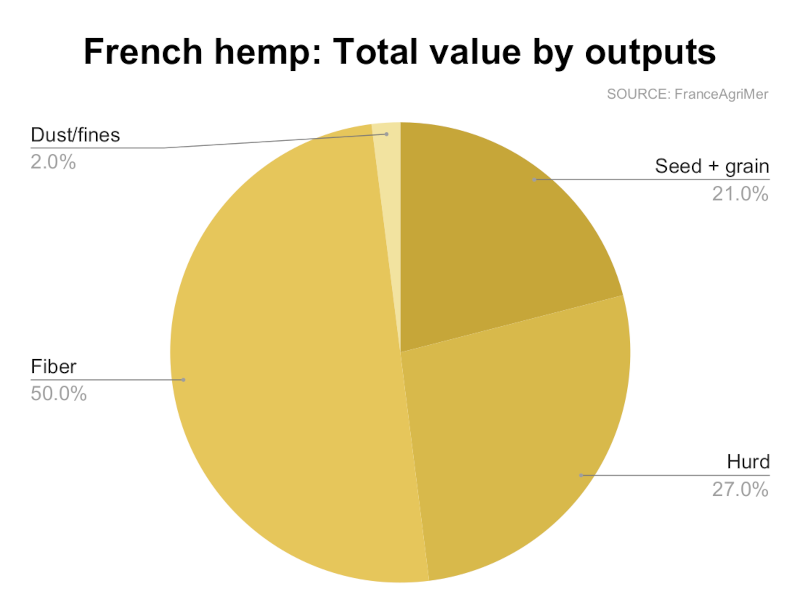
FranceAgriMer’s ‘seed’ category combines both grain/food uses and certified planting seed, an area in which France is a major global supplier of industrial hemp genetics.
Outside France, the Netherlands, at one moment, was reported to be one of the world’s largest exporters of raw/retted hemp, accounting for roughly 30% of global exports, and a top exporter of processed-but-not-spun hemp fiber.
Grand Est leads
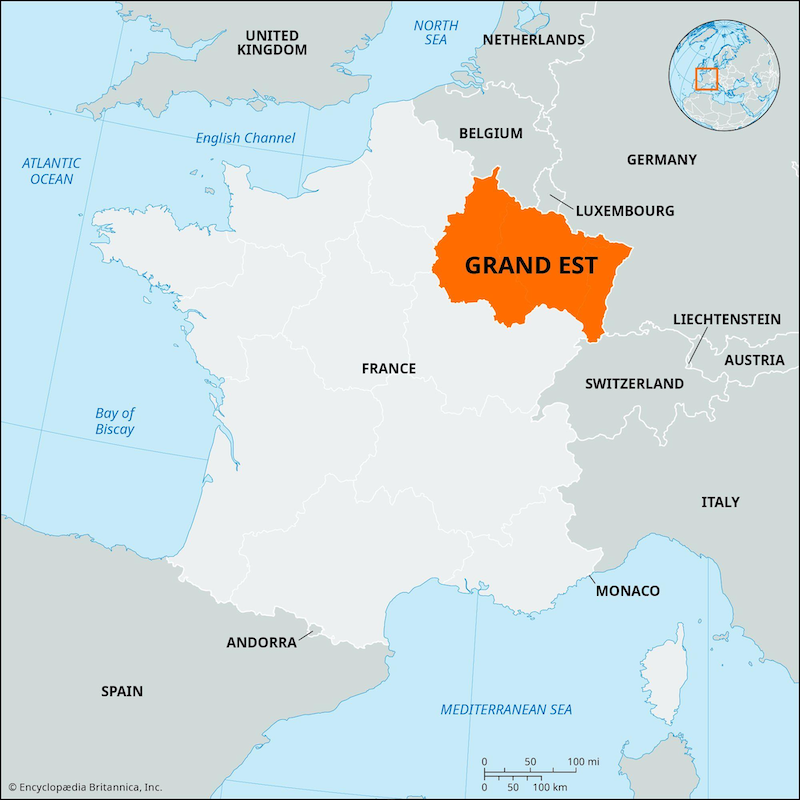
The Grand Est region remains France’s dominant hemp-growing zone and a core industrial cluster for processing and infrastructure.
According to regional agricultural authorities, Grand Est accounted for 11,752 hectares of industrial hemp in 2024 — roughly 46% of hemp area tied to France’s Common Agricultural Policy declarations — with production concentrated mainly in the Aube and Marne departments, in the northeastern corner of the country. Regional hemp acreage has increased sharply since 2019, while organic hemp farming expanded from fewer than 100 hectares in 2015 to roughly 1,500 hectares by 2022, the latest year for which that figure is available.
For comparison, Europe’s leading hemp-producing countries are estimated to account for hemp fields totaling roughly 36,000-38,000 hectares.
The French way
France’s long-established hemp industry is built around the market for certified seed, cooperative processing structures and a focus on fiber and grain markets.
French breeding programs have concentrated on varieties with higher fiber yields and extremely low THC levels. Hemp straw yields range from six to eight metric tons per hectare, while grain yields average roughly one metric ton per hectare, according to the report.
France also continues expanding textile-oriented hemp trials as Europe’s natural fiber supply chains evolve.
Full utilization
The FranceAgriMer overview highlights how extensively France has developed downstream uses for nearly every component of the hemp plant.
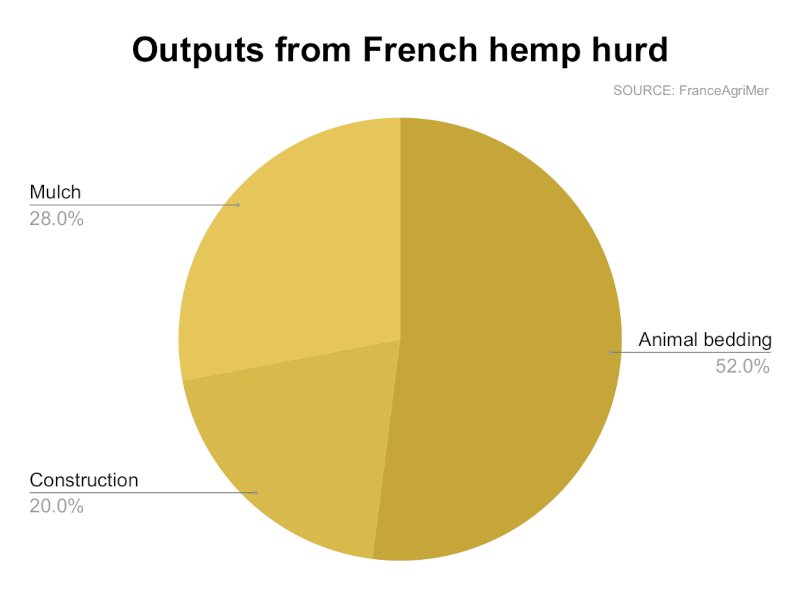
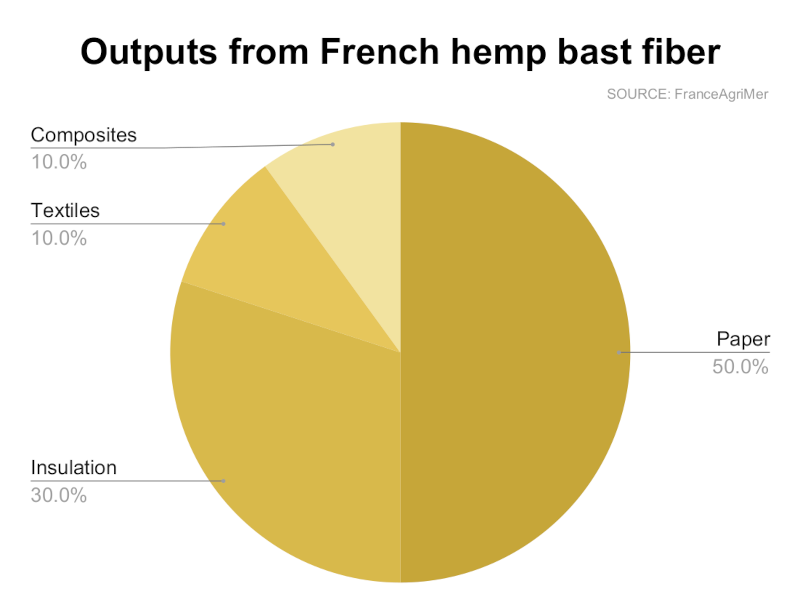
Hempseed is directed mainly into food products, oils and protein ingredients, as well as bird seed and fishing bait. Hurd is used for animal bedding, construction materials and landscaping mulch. Fiber feeds paper, insulation, composite and textile markets, while even low-value dust and fines are recovered for energy production and composting.
The figures also reveal a sharp imbalance between physical volume and economic value inside the French hemp value chain.
Hurd accounts for the largest share of processing output by weight, but fiber generates the highest economic return, accounting for 50% of total value despite making up just 28% of product weight, according to the report.
That imbalance helps explain why many French strategies increasingly focus on higher-value fiber markets tied to construction materials, advanced composites and textile development.
Flowers and extracts remain a relatively small segment of the overall French hemp economy, used mainly in pharmaceutical applications and marginally in cosmetics and food supplements. But changes at the EU level could eventually wipe out most of that business.
Industry structure
France’s hemp sector is organized around InterChanvre, the country’s interprofessional hemp body, which coordinates development efforts between growers and processors. The organization formally excluded flowers from its scope beginning in January 2024, reinforcing the separation between France’s industrial hemp economy and the cannabinoid sector.
InterChanvre works alongside the National Federation of Hemp Producers (FNPC), the Hemp Processors Union (UTC), the technical institute Terres Inovia, seed cooperative HEMP’it, and research organizations including Fibres Recherche Développement (FRD) and the French National Research Institute for Agriculture, Food and Environment (INRAE).
The regional concentration reinforces a defining characteristic of the French hemp industry: production and primary processing infrastructure remain closely linked geographically, allowing France to operate as an integrated industrial system.