
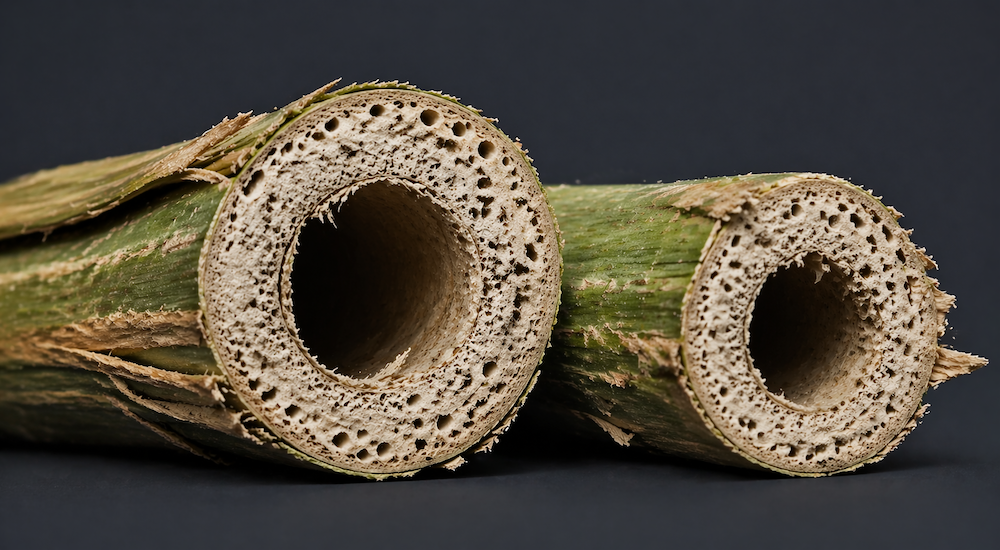
As hemp fiber growers and processors look for stacked revenues from whole-stalk usage, a new peer-reviewed study suggests some waste materials could become inputs for higher-value manufactured goods.
The team that carried out the research, from the U.S. and Korea, said the results showed that underused hemp byproducts can be converted into “high-performance molded fiber packaging materials composed entirely of bio-derived constituents.”
The research team is from the Macromolecules Innovation Institute and the Department of Sustainable Biomaterials at Virginia Tech, and the Department of Food and Nutrition at Kyung Hee University. The study was published in the International Journal of Biological Macromolecules, a peer-reviewed journal from Elsevier, the Netherlands-based scientific publishing company.
Molded model
The team fabricated “fully bio-based molded fiber composites” using industrial hemp byproducts, then evaluated how the materials performed under pressure, bending and impact tests. The results suggest hemp residues could help supply a new generation of stronger, plant-based molded packaging and industrial materials.
The work points toward a processing model in which secondary hemp streams, such as fines, dust, and other residuals, contribute meaningful revenue rather than being discounted or discarded. That would mirror mature agricultural sectors such as corn, which built value through fuel, feed, starches and sweeteners, and timber, which layers revenues through lumber, pulp, pellets and chemicals.
That same whole-plant logic is increasingly relevant in hemp processing, where operators continue searching for better economics beyond a single flagship output.
Packaging shift
While refined hemp bast fibers have long been tested and used on a limited basis in environmentally friendly composites, the new study suggests lower-value residual streams could also find broader, volume-driven outlets in molded products such as protective packaging, trays, lightweight panels, furniture substrates, automotive interior parts and disposable goods.
That would complement earlier efforts focused on bast fiber in automotive and industrial composites rather than replacing them.
The authors said “the development of fully bio-derived molded fiber systems from non-wood agricultural byproducts remains limited and underexplored,” highlighting a gap hemp residues may be able to fill.
Noting that “most existing molded fiber systems continue to rely primarily on wood-derived pulps and, in many cases, incorporate synthetic additives,” the report said, “It is imperative to develop a new generation of molded fiber packaging systems that are truly sustainable and free from toxic chemicals.”
The broader packaging angle aligns with growing interest in hemp fiber for paper, molded packaging and other substitute materials where scale can matter more than premium pricing.
Strong results
In studying the material, the researchers found a sweet spot in the amount of hemp material to add to such mold formulations. Too little fiber weakened the structure, while too much created irregularities.
According to the study, an optimized mid-range formula reached compressive strength above many conventional molded pulp materials cited in prior research, with bending strength nearly doubling versus lighter-load versions.
Those findings add to a growing body of work suggesting hemp’s commercial future may depend as much on smart use of byproducts and secondary streams as on premium long fiber markets alone.