
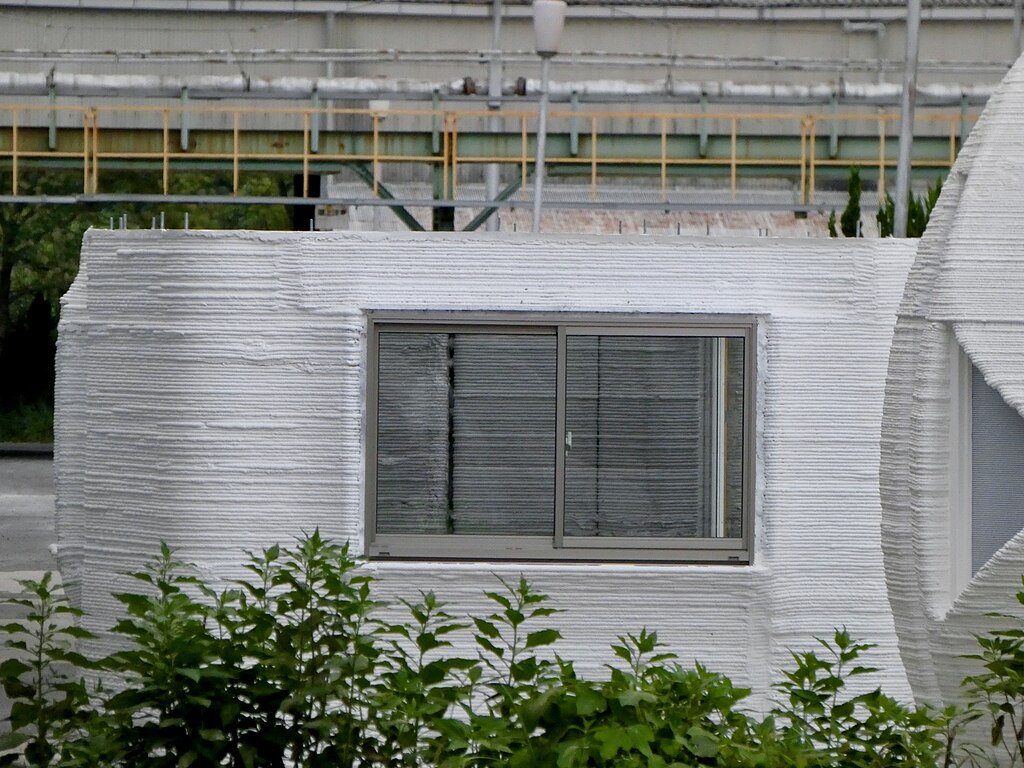
Mixing hemp into 3D-printed concrete introduces clear mechanical tradeoffs that currently limit its structural applications, according to a recent study in Australia.
Tests showed that resistance to bending and cracking fell by 57–60.6% compared with conventional concrete mixes. By contrast, load-bearing capacity under compression dropped by a smaller, though still significant, 45.9–54.8% depending on print direction. The imbalance matters: materials that crack easily face steep hurdles in load-bearing use, especially in layered 3D-printed systems.
The findings come from civil engineering and materials researchers at Western Sydney University, whose study was published in the Journal of Building Engineering. The work is the first systematic experimental assessment of robotic 3D concrete printing (3DCP) using hemp shivs in the mix, moving beyond earlier proof-of-concept trials.
The Journal of Building Engineering is a peer-reviewed construction and materials journal published by Elsevier, one of the world’s largest academic and professional science publishers.
The science
In practical terms, compressive strength measures how much weight a material can safely hold, such as supporting a wall or roof. Flexural strength measures how well it resists bending and cracking — a critical factor for panels, printed walls, and layer-to-layer bonding in 3DCP. In this study, flexural performance degraded more sharply than compressive performance, increasing the risk of cracking at printed layer interfaces.
The researchers created printable mixes by replacing a small portion of the sand in standard concrete with hemp shivs — the woody inner core of the hemp stalk. Between 1 and 4% of the sand was substituted with hemp. Compared with conventional concrete mixes, the hemp-enhanced material flowed more easily through the printer nozzle — about a 16.7% improvement — without materially affecting the stability of printed layers.
That processing benefit came at a high mechanical cost. Strength losses showed up regardless of how the material was printed, pointing to a common problem in 3D-printed construction: the material performs differently depending on the direction in which it is printed.
Limited enviro benefit
At the low hemp content used in the study — roughly replacing 1–4% of the sand in the mix — the environmental benefit is real but limited. Hemp hurd does store biogenic carbon and slightly reduces the use of mined materials, but it does not materially change the cement content, which remains the dominant source of embodied carbon. At these levels, hemp functions as a minor additive rather than a true substitute, meaning the mix should not be characterized as low-carbon or climate-positive based on composition alone.
Claims around healthier buildings – legitimate in traditional hempcrete – are also limited at such a low level of hemp content. Unlike traditional hemp-lime systems that contain much higher levels of plant material, hemp particles in this mix are fully bound within a cement matrix and do not meaningfully affect indoor air quality, moisture regulation, or occupant health. The primary value of the research is therefore not near-term environmental or health impact, but proof that small amounts of plant material can work within automated 3D-printing systems — a necessary early step toward higher bio-content materials in the future.
Sobering
From an investor perspective, the implications are sobering. Structural concrete products must meet conservative building code and certification standards, most of which are written around traditional cast concrete. Materials showing large reductions in bending resistance would face difficult and time-consuming approval pathways, as well as potential resistance from insurers, regulators, and engineers of record.
The study points to possible improvement routes, including pre-treating hemp shivs and refining particle size distribution to improve bonding between printed layers. But those steps would add processing complexity and cost — factors that could narrow hemp’s economic advantage over conventional materials.
Applications limited
In the near term, the results suggest hemp-based 3D-printed concrete is better suited to non-load-bearing applications, such as interior partitions, insulation elements, or architectural features, where cracking risk and structural certification requirements are lower.
While the research confirms that hemp can function within automated 3D printing systems, it also highlights a wide gap between technical feasibility and commercial readiness — particularly for load-bearing construction governed by strict codes and certification frameworks.