
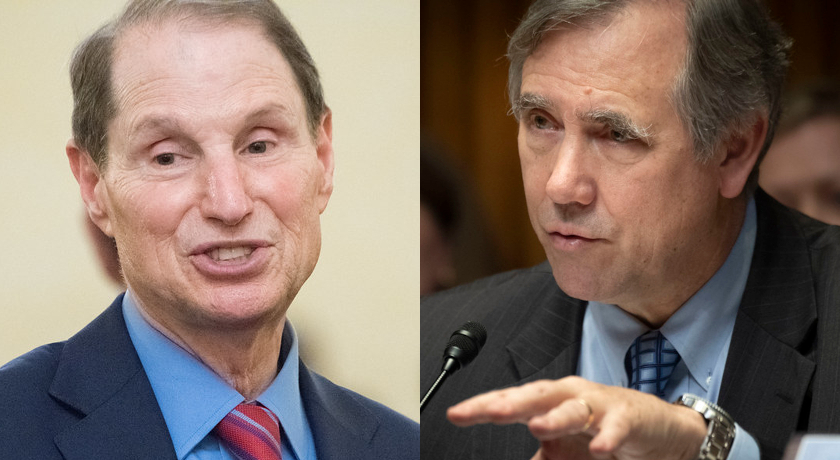
Eight Democratic U.S. senators signed off on a framework that would ban synthetic substances such as delta-8 THC while leaving CBD eligible for use in supplements, foods, and cosmetics under strict rules.
In a Sept. 16 letter from primary authors Oregon Senators Ron Wyden and Jeff Merkley to Senate leaders of both parties, the signatories urged an approach based on regulation instead of out-and-out prohibition of hemp-derived cannabinoids. In addition to Wyden and Merkley, the letter was signed by Sens. Angela Alsobrooks, Maryland; Cory Booker, New Jersey; Martin Heinrich, New Mexico; Chris Van Hollen, Maryland; and John Hickenlooper and Michael Bennet, both of Colorado.
“We write to express strong opposition to the inclusion of any language in S.2256 … or in any continuing resolution or conferenced spending bill that would decimate the American agricultural hemp industry and imperil states’ ability to prevent unsafe hemp-derived cannabinoid products from getting into the hands of children,” the senators wrote.
Passed in early August, S.2256, the fiscal year 2026 Agriculture, Rural Development, Food and Drug Administration, and Related Agencies Appropriations Act — sometimes confused with the Farm Bill — was the vehicle for a Republican attempt to recriminalize hemp intoxicants. Although that language was stripped before passage of S.2256, the broader Farm Bill, delayed since 2023, is still being debated; the matter of hemp intoxicants remains unresolved and is certain to return.
Hyperbole
“If this language were to become law, it would deal a fatal blow to the American farmers, who are the foundation of the regulated hemp industry, and jeopardize tens of billions of dollars in economic activity around the country,” the senators wrote.
The senators claim that “the hemp industry flourished and now supports 320,000 American jobs, generates $28.4 billion in regulated market activity.” The figures are dubious; nobody knows or could confirm such numbers – that’s another story.
Still, the intent of the letter is clear. In addition to the ban on synthetic intoxicants, the senators propose restricting CBD and other hemp-derived cannabinoids in supplements, foods, beverages, and cosmetics by:
- Limiting sales to adults 21 and older
- Standardizing packaging and labeling to stop candy lookalikes aimed at kids;
- Requiring independent third-party testing for consumable hemp products.
Three-legged stool
The senators point to the danger of “re-criminalizing any quantifiable levels of THC,” a blunt approach that would “make illegal all existing and future development of dual cultivars used by farmers to produce grain and cannabinoids, or fiber and cannabinoids, from one hemp crop.”
“Re-criminalizing cannabinoid products cuts off one leg of the hemp market’s stool, and it will topple if this language is included in any final spending bill,” according to the senators.
In other words, banning traces of THC could also take down legitimate hemp markets in grain and fiber along with CBD, the senators argue. (That’s a stretch, and rather unlikely.)
The senators warn that a proposal by Republican Kentucky Sen. Mitch McConnell to outlaw products with “quantifiable” THC would “imperil the market for non-intoxicating hemp CBD products,” since no crop can produce CBD that is absolutely free of THC traces. “By arbitrarily changing the definition of a crop to regulate finished products, Congress would effectively turn out the lights on America’s law-abiding hemp farmers,” they wrote.
States have stepped in
In dealing with intoxicating hemp, individual states have not waited for Washington. Some have banned the substances outright while others have put on strict controls, with a few treating the substances the same as marijuana and limiting them to state-licensed dispensaries.
The Wyden-Merkley letter positions itself as a national answer. It acknowledges that “hemp-derived cannabinoid products, when left unregulated, present safety concerns,” but insists total prohibition is the wrong tool. The proposed framework would shut the door on synthetics while keeping CBD intact for non-intoxicating uses. That is a sensible distinction — separating the dangerous intoxicants from CBD as a supplement or additive.
Here we meet another elephant in the room: the U.S. Food and Drug Administration (FDA), has dragged its feet for years on setting rules for CBD itself. Despite the compound’s ubiquity in supplements, foods, and cosmetics, the agency has never issued clear standards for dosage, labeling, or safety.
The real danger
That leaves the CBD trade in a legal gray zone — tolerated, but not fully regulated. Even if the senators’ framework advances, establishing a lawful, reliable pathway for CBD products remains another hill not yet climbed.
But first, there’s a skirmish closer at hand. As an exclusively Democratic initiative, and given the current political environment, the framework presented in the Wyden-Merkley letter could end up as more stillborn policy.
The hemp intoxicant market may be reckless, but in Washington, D.C., partisanship remains the most dangerous substance of all.