
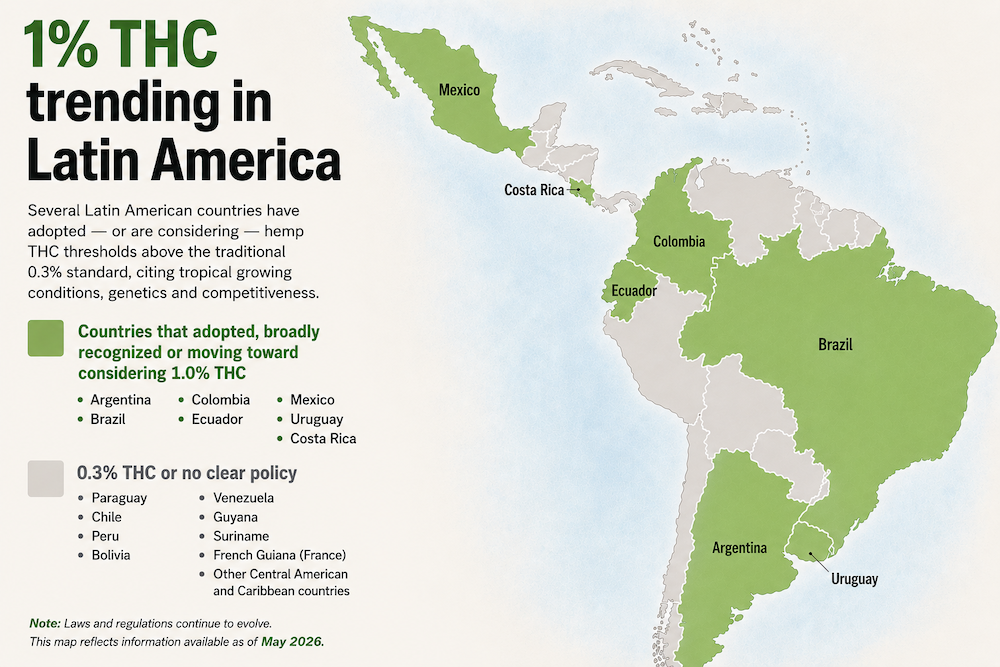
Brazilian hemp stakeholders are continuing to press for a 1.0% THC threshold for industrial hemp “in the field,” arguing that the long-standing 0.3% benchmark is poorly suited to tropical growing conditions and could undermine the country’s competitiveness in the global hemp sector.
The latest push comes in the form of a newly disclosed policy paper jointly prepared by the Brazilian Agricultural Research Corporation (Embrapa), HempTech Brasil and the Ficus Institute. The document was first tracked down and reported by CannaReporter.
The paper (Technical Note No. 01/2026) is an expert advisory document aimed at regulators and policymakers as Brazil develops its hemp framework. It argues that the 0.3% THC benchmark “should not be treated as scientific dogma” and says tropical climates can naturally elevate THC expression even in legitimate industrial hemp cultivars.
Getting ready
Although Brazil has not yet established a broad industrial hemp framework, stakeholders are seeking to influence the definition of hemp before those rules are finalized.
A higher THC threshold would be a boon to Brazil’s medical CBD market because CBD and THC levels tend to rise together in hemp plants. A 1.0% limit would give growers access to a wider range of CBD-rich genetics, enabling more efficient production.
A 1.0% threshold would also reduce the risk of otherwise viable hemp crops exceeding legal THC limits. Depending on how the rules are eventually written, over-the-limit crops can carry fines and other financial consequences for growers.
The arguments advancing the 1.0% THC limit largely reinforce positions already advanced publicly by Embrapa researchers and hemp stakeholders over the past several years, as Brazil gradually moves toward a formal industrial hemp framework.
Ongoing debate
While the 0.3% THC threshold became widely adopted internationally through North American and European regulatory systems, hemp advocates have long argued the benchmark was never intended as a universal scientific standard.
Under tropical and subtropical growing conditions, plants can naturally express higher THC levels than the same genetics grown farther from the equator. Stakeholders say a strict 0.3% THC limit could exclude productive hemp varieties that are not suitable for drug use but may naturally test above the threshold in the field.
The technical note argues that THC percentages should be interpreted within broader agronomic and commercial realities rather than through rigid application of inherited regulatory standards.
Embrapa researchers publicly argued last year that Brazil should adopt a 1.0% THC limit to remain competitive internationally, particularly against countries in Latin America that already operate under more flexible standards. Argentina, Uruguay, Costa Rica, Ecuador and Mexico are operating at that higher level. Colombia set the THC limit for grain and fiber crops at 0.3%, while allowing up to 1.0% THC for flower production tied to cannabinoid extraction.
Regulatory path
Brazil’s hemp framework remains under development. Current rules approved by the National Health Surveillance Agency (Anvisa) allow tightly controlled cultivation of cannabis plants containing up to 0.3% THC for medical and scientific purposes – primarily CBD.
Those rules do not yet establish a system for fiber and grain production, and stakeholders continue to press regulators and lawmakers for a clearer commercial framework.
Earlier discussions around Brazil’s THC limits emerged even before the Anvisa rules were finalized, when hemp advocates and researchers began arguing that tropical countries require a different regulatory approach than colder-climate hemp producers.
The organizations behind the paper represent a mix of scientific, policy and industry expertise. Embrapa is the country’s leading agricultural research agency; HempTech Brasil is a hemp research and policy initiative; and the Ficus Institute is a nonprofit that works on cannabis policy, regulation and market development in Brazil.