
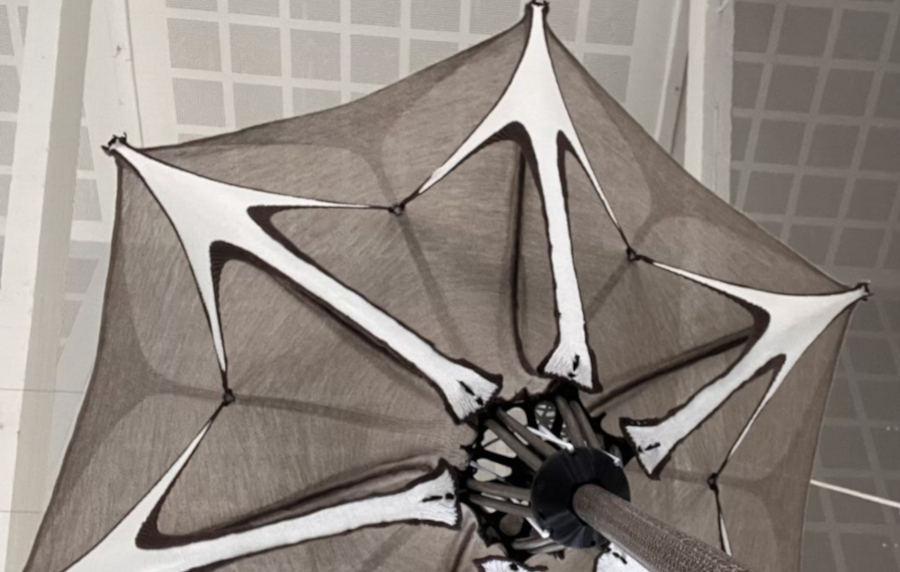
A new architectural prototype suggests European researchers and industry partners are making progress toward using long-fiber hemp in structural composite applications, a development that could open higher-value markets in construction and other engineered products.
The Hemp Halo Canopy, a 3.3-meter architectural structure developed through the European Union-funded RAW project, uses a special manufacturing process to combine hemp-based structural elements and hemp textile surfaces in what organizers describe as the first lightweight architectural system made entirely from hemp.
RAW is a European research initiative focused on advancing bio-based materials and manufacturing technologies for industrial and construction applications.
The project was presented at this year’s JEC World, a Paris-based international trade show dedicated to composite materials and advanced manufacturing.
The demonstration is significant because it highlights a manufacturing process that could allow hemp fibers to compete in technical applications traditionally dominated by fiberglass composites. Researchers say bast fibers such as hemp and flax offer combinations of stiffness, vibration damping and lower embodied carbon that could make them suitable for uses beyond traditional textile, insulation and nonwoven products.
Hemp ‘pultrusion’
The Hemp Halo structure relies on two advanced manufacturing techniques. Structural members are made through pultrusion, a process that pulls hemp fibers through a resin system to create lightweight, high-strength profiles. The canopy surface is made from hemp yarn formed by computer-controlled knitting machines that can create complex textile shapes with minimal material waste.
According to the Alliance for European Flax-Linen & Hemp, recent advances in long-fiber hemp processing have made high-strength hemp pultrusion a viable manufacturing route. The Hemp Halo was developed to demonstrate those capabilities in a full-scale architectural structure.
Future development will likely focus on validating the mechanical properties of the pultruded hemp profiles, refining resin systems, evaluating production economics and benchmarking performance against conventional fiberglass pultrusions. Those factors will ultimately determine whether the technology can move beyond demonstration projects into commercial construction and industrial markets.
Industry partners
The project brings together participants from across the European hemp and composites value chain. Partners include France-based fiber companies Terre de Lin and Safilin; Italy’s Linificio e Canapificio Nazionale and Polynt; the Netherlands’ Eindhoven University of Technology and Infra Composites; Switzerland-based natural-fiber composites developer Bcomp; and Luxembourg-based materials manufacturer Armacell.
Also highlighted at JEC World was BastWave, a corrugated biocomposite cladding system manufactured from hemp fibers and bio-resin that has already been installed at London’s Young V&A Museum.