
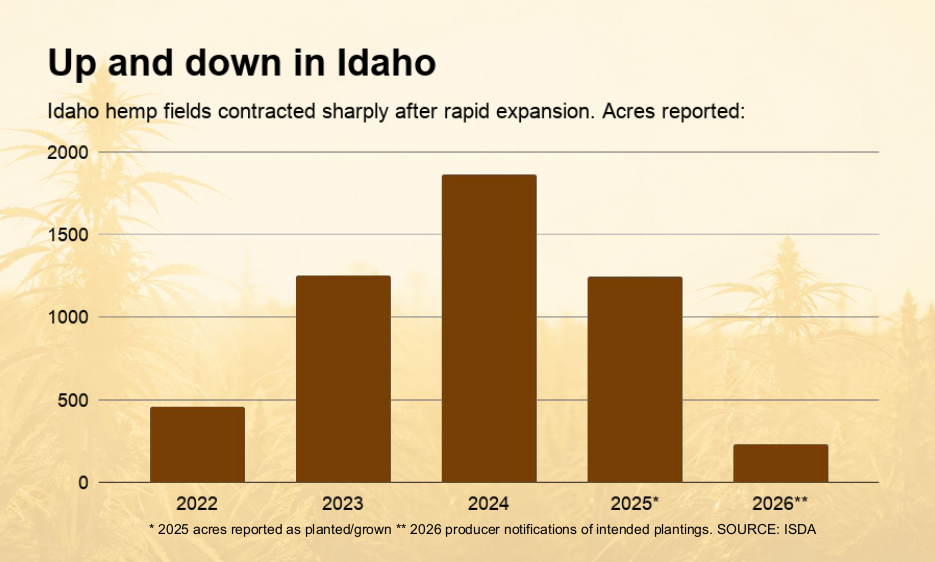
After quickly becoming one of the nation’s leading hemp fiber-producing states a few years ago, Idaho growers say they are planting just 233 acres in 2026, an 81% drop from last year and the state’s lowest level since hemp production was legalized in the state.
The sharply lower acreage, reported by the Idaho State Department of Agriculture (ISDA), follows several years of rapid expansion in the fiber-focused hemp sector. Industry observers say processors and growers continue to work through inventories.
Growing pains
Idaho farmers planted 458 acres of hemp in 2022, the first year commercial production was allowed under the state’s industrial hemp program. Acreage climbed to 1,248 acres in 2023 before peaking at 1,860 acres in 2024. Plantings then fell to 1,242 acres in 2025 before falling by more than 1,000 acres this year.
“While the state’s hemp acres have fallen since reaching a high in 2024, the crop is by no means dead in Idaho,” said Braden Jensen, director of governmental affairs for the Idaho Farm Bureau Federation, who helped craft the legislation establishing the state’s hemp program.
“Idaho farmers know how to grow a crop and if anyone can figure it out, they can. I think hemp will continue to take baby steps in Idaho as farmers continue to pioneer the crop’s future here,” Jensen said.
Idaho was the last U.S. state to legalize the production and processing of industrial hemp after Congress authorized commercial hemp under the 2018 Farm Bill. The state’s program requires growers and processors to obtain licenses from ISDA, while transportation of hemp is limited to licensed participants or those acting on their behalf.
THC rules
Beginning July 1, Idaho will bring its regulatory framework much closer to the federal approach under House Bill 772, signed by Gov. Brad Little in April.
Federal law defines industrial hemp as cannabis containing no more than 0.3% THC on a dry-weight basis. However, federal regulations also recognize that weather, genetics and other environmental factors can push THC levels above that threshold despite a producer’s good-faith compliance.
Previously, any crop exceeding the state’s acceptable hemp THC level could be treated as a negligent violation. Three negligent violations within five years could disqualify a producer from the state’s hemp program for five years.
Some slack
Under the new law, growers producing hemp solely for fiber or grain will not receive a negligent violation if they made reasonable efforts to comply with Idaho’s hemp regulations and state hemp plan, and their crop tests no higher than 1.0% total THC on a dry-weight basis.
The change mirrors one of the key producer protections in the 2018 Farm Bill by distinguishing between inadvertent regulatory violations and more serious offenses. Crops testing between 0.3% and 1.0% THC may still be subject to destruction or other state requirements, but producers acting in good faith will no longer automatically accumulate negligent violations.
The revised framework is expected to reduce production risk for Idaho’s fiber and grain growers.
Consumables
Lawmakers also approved House Bill 879 during the 2026 legislative session. The measure makes clear that retailers and other establishments selling hemp products intended for human ingestion or inhalation fall under Idaho’s Industrial Hemp Research and Development Act. Previously, state law clearly regulated hemp cultivation and processing but was less explicit about products sold directly to consumers.
HB 879 closes that gap by extending existing hemp compliance requirements to consumable products, while specifically exempting nonviable hulled hemp seed, hemp seed protein powder and hemp seed oil.
The law does not authorize any new categories of hemp products, nor does it create a new retailer licensing program or impose additional fees; instead reaffirming that consumable hemp products must meet Idaho’s existing legal standards, including the state’s strict limits on THC content.