
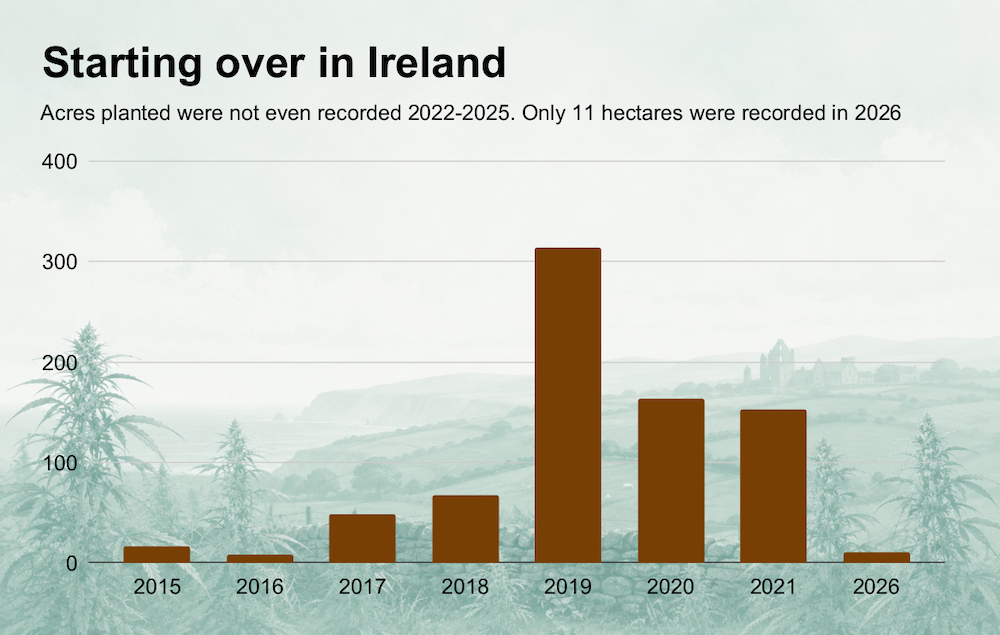
Ireland’s industrial hemp sector remains largely dormant, with only about 11 hectares registered for cultivation this year, as Parliament examines regulatory and commercial barriers that have kept the crop from developing into a meaningful business sector.
The figure underscores the gap between hemp’s potential and the industry’s commercial reality in a post-CBD hemp world, according to testimony during recent hearings before the Oireachtas Joint Committee on Agriculture and Food.
Ireland hemp plantings reached a peak of just 314 hectares in 2019, while the Health Products Regulatory Authority (HPRA) reported 547 hectares were licensed that year.
‘Sustainability commitments’
The committee invited government officials and stakeholders to explain why the sector has failed to develop and what policy changes are needed. Government officials, researchers and industry representatives told the hearings that hemp could serve markets ranging from construction materials to biocomposites, textiles and food, but said lack of investment and current regulations continue to hold the sector back.
“Recognizing the income pressures facing Irish farm families and the need for more resilient and sustainable agricultural systems, Teagasc’s Rural Economy Development Programme actively supports farmers in exploring diversification opportunities,” Barry Caslin, a specialist with Ireland’s Agriculture and Food Development Authority (Teagasc), said in a statement opening the hearings.
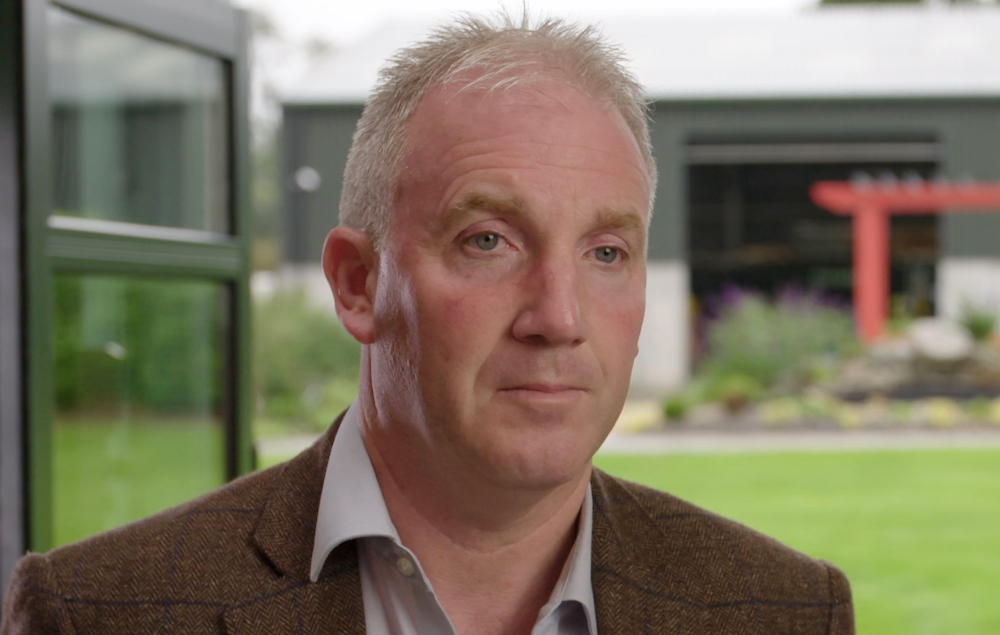
“By integrating hemp into our agricultural and industrial systems, Ireland can advance its climate and sustainability commitments,” Caslin said, stressing that Teagasc is committed to supporting the sector through research and technical guidance.
The hearings build on earlier government work. In 2021, the Department of Agriculture, Food and the Marine (DAFM) launched a consultation on fiber crops, and in 2022, it concluded that hemp fiber production was not commercially viable at the time.
Several witnesses argued that conclusion should now be revisited as markets and technology have evolved.
Infrastructure gaps
“The missing piece is processing infrastructure. Farmers will not commit land at scale unless they know the crop can be processed,” Eugene Morgan, director of Connacht Fibre Ltd., told lawmakers.
Teagasc’s Caslin also told the hearings that primary processing infrastructure is needed.
Officials from the DAFM told lawmakers hemp is well suited to Irish growing conditions but said commercial development ultimately depends on private investment rather than government-led industrial development.
Ireland continues to regulate hemp cultivation under its controlled drugs framework, also a significant barrier. Growers must obtain licenses each year from the HPRA instead of an agricultural agency. Stakeholders say the drug-control approach emphasizes enforcement rather than agricultural development, and creates uncertainty that discourages long-term investment in contracts and supply chains.
‘Missed opportunity’
While demand is emerging for natural fibers in construction materials, insulation products and biocomposites, Ireland has no established decortication or textile-processing chain capable of serving those markets at commercial scale. Farmers therefore have little incentive to expand production without reliable buyers, while investors remain reluctant to build processing facilities without assured feedstock supplies.
Daniel Lyons, founder and director of Wild Atlantic Hemp, said the disconnect is especially frustrating because Irish manufacturers already use hemp in commercial products. “An Irish company, Kingspan, is leading the way in hemp-based insulation, yet the hemp is sourced through mainland Europe rather than from Irish farms,” he said. “To me, that’s a missed opportunity for Irish agriculture. We need to be producing these materials here in Ireland.”
The committee has not indicated when it will issue its findings or whether it intends to recommend changes to Ireland’s hemp regulations. Any reforms would ultimately require action by the government, but the hearings have put renewed parliamentary attention on a sector that has struggled to move beyond pilot projects despite years of research and industry advocacy.