
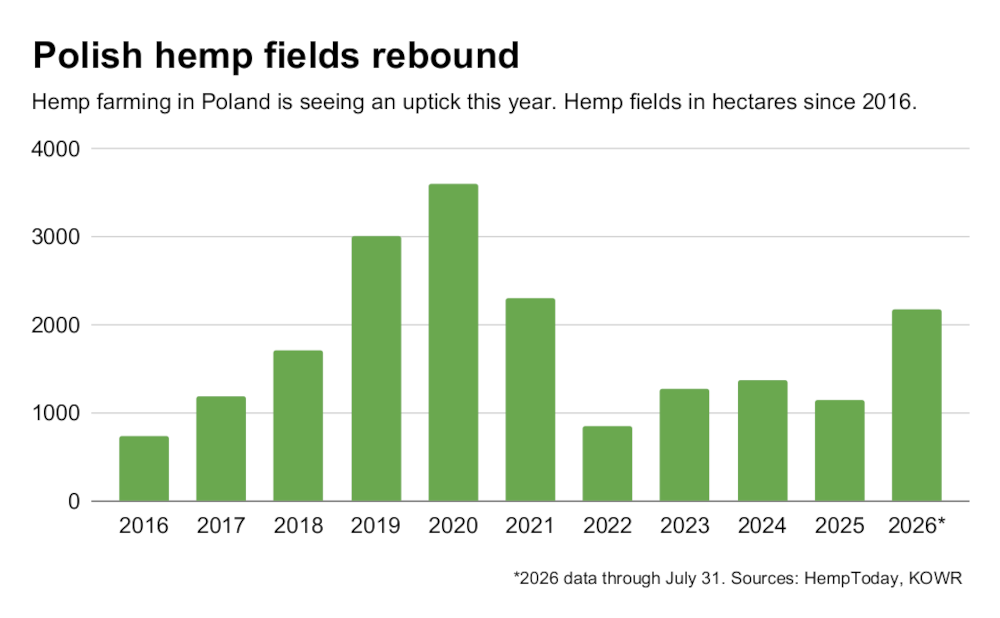
Polish hemp fields have nearly doubled this year, reaching roughly 2,171 hectares by the end of July as the number of registered producers continues to rise under a simplified regulatory system introduced four years ago.
The 2026 area is up 89% from 1,146 hectares at the end of 2025 and is the highest recorded since Poland replaced its old cultivation-permit system with a national registry in 2022, according to the National Center for Agricultural Support (KOWR), the government agency that maintains the country’s industrial hemp registry,
‘Real demand’
“There is real demand behind it this time, as opposed to the previous uptick” in Polish fields, said Polish hemp veteran Maciej Kowalski of leading European hemp company Kombinat Konopny, noting that a bump in total hemp fields to more than 3,000 hectares in 2020 was driven mainly by speculators at the tail end of the global CBD bust.
The current expansion also looks different to Witold Czeszak, who heads the Polish Hemp Program at the Institute of Natural Fibers and Medicinal Plants (IWNiRZ), a state research center. “With grain and fiber varieties dominating fields again, Poland’s hemp sector is moving back toward its roots in the crop’s traditional industrial foundations,” he said.
The number of registered growers this year reached 1,681 by July 31, up from 1,592 at the end of 2025 and 425 during the transition year in 2022, KOWR reported. The number of companies and other entities registered to buy hemp from growers has moved in the opposite direction, falling from 87 in 2024 to 76 this year.
Poland’s 2022 reforms eliminated annual cultivation permits and regional restrictions, replacing them with registration through KOWR while setting the national THC limit at 0.3%.
The reforms followed several years of ups and downs. Polish hemp fields peaked at roughly 3,500 hectares in 2020, before collapsing as the CBD biomass market unraveled and a flap over the popular FINOLA grain variety blocked some EU subsidies for hemp in Poland.
Grain leads
Henola, a Polish grain variety developed at IWNiRz, currently accounts for about 833 hectares, more than one-third of the country’s hemp fields. FINOLA, a Finnish variety, has meanwhile rebounded among Polish grain growers; Poland’s Białobrzeskie and France’s Futura 75, both primarily fiber varieties, are also among the most widely planted cultivars in Poland.
Grain demand in Poland is being driven mainly by the animal feed subsector, with some farmers reporting their hemp crops are bringing in more income than other traditional grains. Hemp stakeholders in Poland hope to build on the feed market to develop protein powders and similar high-nutrition supplements for human consumption.
The largest hemp farming areas in Poland this year are in the Lubelskie region in eastern Poland at the Ukrainian border; and the Warmińsko-Mazurskie and Kujawsko-Pomorskie regions in north-central Poland.