
An Irish High Court challenge could force a ruling on whether the country can continue treating industrial hemp as a controlled drug, potentially addressing one of the regulatory barriers that have helped reduce Ireland’s hemp sector to almost nothing.
The case involves Brendan O’Mara, a member of Hemp Federation Ireland (HFI), who faces a criminal charge following a May 2025 seizure at his home in County Clare. He has pleaded not guilty.
Proceedings in Ennis District Court have been adjourned while the High Court considers O’Mara’s challenge to Ireland’s treatment of hemp containing no more than 0.3% THC.
His challenge seeks declarations that including such hemp under Schedule 1 of Ireland’s Misuse of Drugs Act is unlawful under European Union law, that qualifying hemp is an agricultural good, and that the Irish drug-control framework conflicts with EU legislation.
O’Mara’s solicitor, Ted McCarthy, told the District Court that two pending cases before the European Court of Justice could affect the Irish proceedings. The cases, from Italy and the Netherlands, raise related questions over whether national drug laws can restrict low-THC hemp that complies with EU agricultural rules, including restrictions on hemp flowers and other plant parts and on the possession or movement of legally produced hemp between EU member states.
Legal test
The case brings before the courts a regulatory conflict that Ireland’s small hemp industry has raised for years: Farmers can obtain licenses to grow EU-approved industrial hemp, while Irish drug rules severely restrict what parts of the harvested plant can be used.
Hemp cultivation is licensed annually by the Health Products Regulatory Authority (HPRA), an agency under the Department of Health, rather than being regulated solely as an agricultural crop. Leaves and flowers have generally been treated as controlled material and must be destroyed, leaving farmers primarily with stalks, fiber and seed.
Those restrictions have long frustrated development of the sector. The contradiction was already evident in 2019, when Irish growers complained that the government permitted cultivation while drug laws prevented commercial use of important parts of the crop.
Industry collapse
The legal challenge comes as Ireland is already reconsidering why its hemp industry has failed to develop.
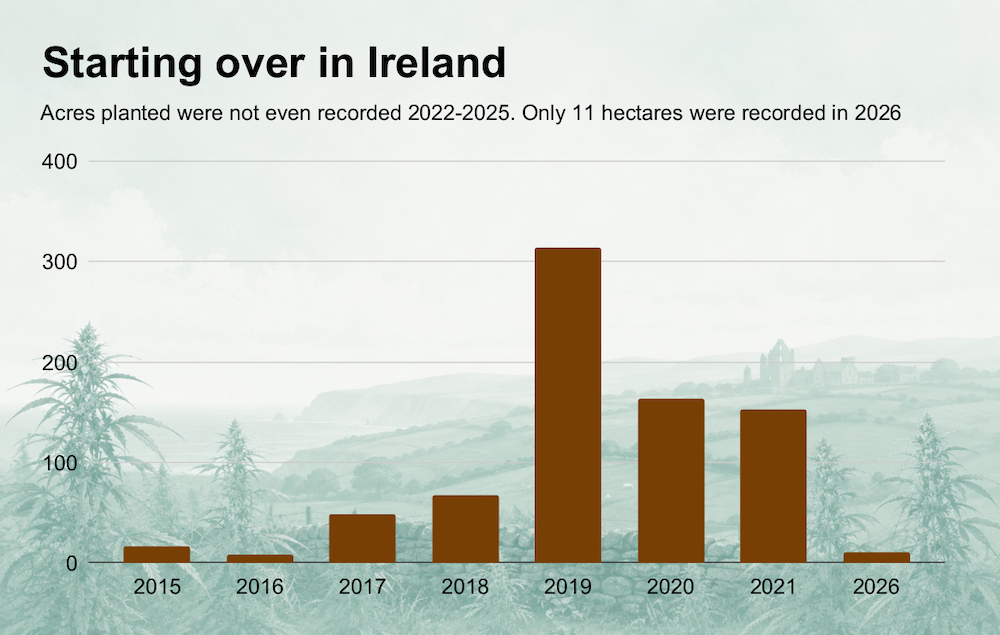
Only about 11 hectares of hemp were registered for cultivation in 2026, according to figures presented this summer during hearings before the Oireachtas Joint Committee on Agriculture and Food. Plantings peaked at roughly 314 hectares in 2019.
Lawmakers heard that lack of processing infrastructure remains a major obstacle, while witnesses also identified the controlled-drugs framework as a significant barrier to investment and commercial development.
Ireland’s rules also sit against changes in EU agricultural policy. The EU threshold for hemp eligible under the Common Agricultural Policy was raised from 0.2% to 0.3% THC beginning in 2023.
Seizure disputed
The O’Mara case arose after Irish police seized material at his home in May 2025. He was subsequently charged with possession of cannabis for sale or supply under the Misuse of Drugs Act.
Prosecutors have characterized the seized material as cannabis with an estimated illicit-market value running into millions of euros. O’Mara’s solicitor has told the District Court that the material is low-THC hemp that would be regarded as an agricultural good elsewhere in Europe.
The composition, origin and intended use of the seized material remain matters for the courts.
HFI said in a statement this month that assigning an illicit-cannabis street value to material alleged to be industrial hemp effectively assumes the legal classification that the High Court is being asked to decide.
The federation said Irish practice since 2018 has treated almost the entire hemp plant as a controlled drug except mature stalk, fiber and separated seed, an approach it argues is substantially narrower than the EU agricultural framework.
Parallel case
HFI members are also pursuing a separate judicial review that challenges Ireland’s hemp restrictions on another EU-law basis.
That case alleges Ireland failed to notify the European Commission under Directive (EU) 2015/1535 of national measures that HFI says effectively prohibit commercial uses of an EU agricultural crop. The directive requires member states to notify the Commission of certain proposed national technical regulations before they take effect.
HFI argues that failure to make such notification can make a national technical rule unenforceable against individuals. That claim remains before the courts and is separate from O’Mara’s criminal proceedings and High Court challenge.
The District Court has adjourned O’Mara’s prosecution until Dec. 9 while awaiting developments in the High Court.