
A group of U.S. senators are urging the Department of Justice to investigate Chinese criminal organizations they say could be exploiting the federal loophole that allowed intoxicating hemp products to flourish, putting the hemp controversy into a broader federal crackdown on Chinese-run illegal marijuana operations.
The senators specifically pointed to the 2018 Farm Bill, which legalized hemp federally but created a loophole subsequently used to produce psychoactive products from hemp-derived cannabinoids. They asked Attorney General Todd Blanche to investigate financing, land ownership, chemical imports and possible links to the Chinese Communist Party behind Chinese transnational criminal organizations operating in U.S. cannabis markets.
“Leaving the loophole unaddressed would give these networks additional time to flood American commerce with synthetic products,” the senators wrote in the Sept. 29 letter. “This would also further entrench their operations on American soil, fund their enterprises with illicit revenue, and expose consumers to unregulated, dangerous synthetic products masquerading as legal hemp.”
The letter does not necessarily establish that Chinese marijuana networks are also significant operators in the U.S. intoxicating-hemp market, but the requested DOJ investigation could determine whether the two markets intersect.
Sens. Tom Cotton of Arkansas, Ted Budd of North Carolina, Pete Ricketts of Nebraska and Susan Collins of Maine, all Republicans, signed the letter to the U.S. Attorney General.
Hemp deadline
The warning comes as most of the U.S. intoxicating-hemp market approaches a Dec. 11 deadline that could eliminate many products now sold outside state-regulated marijuana systems.
A federal spending law enacted last year rewrote the definition of hemp, including a highly restrictive limit of 0.4 milligrams of total THC per finished container. Congress recently delayed most of the new restrictions from Nov. 12 until Dec. 11.
The restrictions are aimed primarily at intoxicating products such as delta-8 THC — the best-known intoxicant to emerge from the Farm Bill loophole — along with delta-10 THC, HHC, THCP and THC-O, as well as hemp-derived delta-9 THC and high-THCA flower. Most are produced by chemically converting hemp-derived CBD or other hemp cannabinoids. The 0.4-milligram limit, however, also threatens conventional non-intoxicating CBD products, an issue that remains under debate in Congress.
Marijuana focus
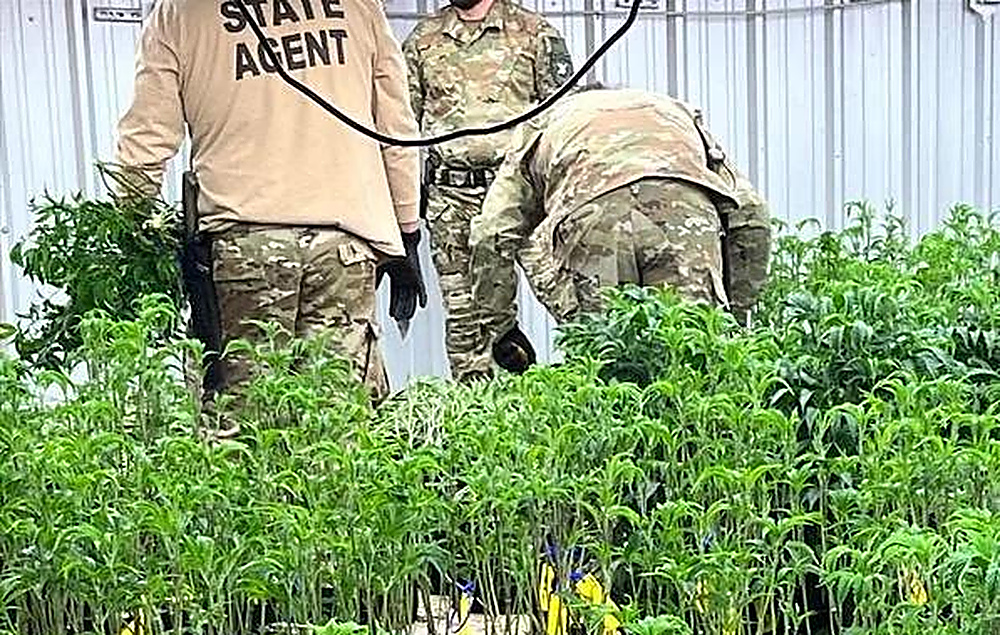
Chinese operations have surfaced directly in past hemp-related cases. A New Mexico operation promoted as legal hemp was exposed as a massive illegal marijuana enterprise involving Chinese investment and Chinese workers. In that case, former Navajo Nation politician and hemp advocate Dineh Benally pleaded guilty to federal charges involving marijuana trafficking, undocumented workers, Chinese pesticides and environmental violations.
The evidence cited by the senators against Chinese criminal networks, however, overwhelmingly concerns illegal marijuana rather than hemp-derived intoxicants.
The Drug Enforcement Administration’s 2025 National Drug Threat Assessment said Chinese transnational criminal organizations had become major operators in domestic marijuana cultivation and distribution, particularly in states with legal cannabis markets. California enforcement teams linked Chinese or other Asian criminal organizations to 161 of 855 illegal cultivation sites examined in 2024, accounting for 35% of the roughly 900,000 plants eradicated and 41% of processed marijuana seized.
China and CBD
China has long been a significant producer of the CBD that feeds markets abroad. Yunnan province has been a major global CBD supplier, with the majority of production exported to the United States. Yunnan and Heilongjiang operate legal hemp cultivation and CBD processing programs under tight controls.
The Yunnan Provincial Department of Science and Technology reported last year that Yunnan Hanmeng Pharmaceutical operates what it described as China’s largest industrial hemp processing line and exports cannabinoids, particularly CBD, to European and U.S. markets. Those exports had grown roughly 30% annually during the preceding three years, the agency said.
China nevertheless sharply restricts CBD at home. National regulators banned CBD, cannabis leaf extract, hempseed oil and related cannabis ingredients from cosmetics in 2021, while CBD and CBD-containing products are not permitted for domestic use or import. That effectively shut CBD out of mainstream consumer products even while licensed production for export continued.