
The U.S. Congress has delayed sweeping restrictions on hemp-derived cannabinoid products for one month, giving lawmakers more time to protect legitimate wellness CBD while reopening a broader fight over whether some of the intoxicating products targeted by the crackdown should survive under federal regulation.
Beverages containing synthetically boosted THC have the clearest proposal for survival, with bipartisan legislation floating around that would put them under an alcohol-style regulatory system. But the additional month also gives producers of gummies and other intoxicating hemp products another chance to press for federal rules instead of prohibition.
The House approved the Senate-passed Continuing Appropriations and Extensions Act in a 370-48 vote Tuesday. The measure, which funds the federal government through Dec. 11, now goes to President Donald Trump.
Key provisions of the new federal definition of hemp that were to take effect Nov. 12 are delayed until Dec. 11.
One part of the crackdown still takes effect Nov. 12: products containing cannabinoids that cannot occur naturally in the cannabis plant will lose their federal hemp status. The remaining restrictions are delayed until Dec. 11, including those covering cannabinoids that can occur naturally but are manufactured outside the plant, and the 0.4-milligram-per-container THC limit for finished products.
That means much of the intoxicating-hemp market also gets another month. Products containing hemp-derived THC, high-THCA products and cannabinoids that occur naturally but are commercially produced through conversion remain caught in the broader crackdown, but those restrictions now take effect Dec. 11 unless Congress changes the law again.
CBD gets time
The delay gives Congress another month to address one of the most serious unintended consequences of the crackdown: its threat to conventional cannabidiol (CBD).
Congress last year rewrote the federal definition of hemp after a multibillion-dollar gray market in delta-8 THC, THCA flower, HHC, THC-P and other intoxicating products flourished under the 2018 Farm Bill. The law adopted a broader total-THC standard, excluded certain synthetic and converted cannabinoids, and established a one-year transition period.
OUR COVERAGE OF THIS ISSUE
- Hijacking hemp: U.S. trade group plays loose with facts in a whining letter to Trump
- Industry’s failure to address intoxicating hemp products is height of irresponsibility
- Federal axe falls on intoxicating hemp, bringing an uneasy chapter to an end
- Good riddance to intoxicating hemp. Now, let’s move on
But the law also established a super-low limit of 0.4 milligrams of total THC per container for finished cannabinoid products. That threshold is low enough to eliminate many conventional full-spectrum CBD wellness products that contain naturally occurring trace amounts of THC but do not produce an intoxicating effect.
Federal policy has left CBD in an uncertain position for years. Products are widely available, but the U.S. Food and Drug Administration (FDA) has never established the comprehensive regulatory framework the industry sought for CBD in foods and dietary supplements.
The additional month gives lawmakers another opportunity to distinguish non-intoxicating wellness products from the psychoactive market that prompted Congress to act.
Fight goes on
The 2018 Farm Bill legalized hemp based primarily on a 0.3% delta-9 THC threshold. Producers subsequently used hemp-derived CBD as feedstock to manufacture psychoactive compounds and marketed the resulting products under the legal umbrella created for hemp.
Delta-8 THC and other intoxicants spread rapidly, followed by gummies, candies, vape products, high-THCA flower and other products sold through convenience stores, gas stations, smoke shops and online outlets far outside state-regulated marijuana systems.
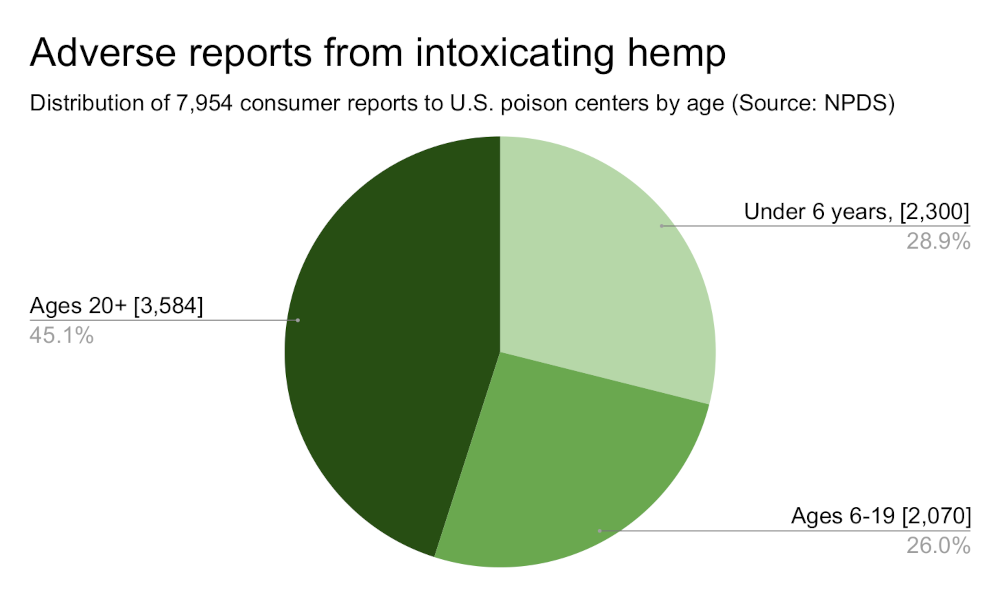
Reports of health problems and at least one death were attributed to the illicit products.
The resulting backlash eventually led Congress to adopt the new hemp definition. By this year, political support for the largely unregulated market had weakened considerably. In June, the House Rules Committee rejected three attempts to postpone or modify the coming restrictions.
But the extension has given proponents another month to argue for regulation rather than prohibition.
Rep. Morgan Griffith, a Virginia Republican who chairs the House Energy and Commerce Subcommittee on Health, said the delay “gives lawmakers additional time to consider a federal regulatory framework for intoxicating hemp-derived products.”
Griffith has introduced the Hemp Enforcement, Modernization, and Protection (HEMP) Act, which would put hemp-derived products intended for human consumption under an FDA regulatory framework.
“American producers and consumers deserve nothing less than a system that upholds oversight, responsibility and safety,” Griffith said after the House vote. “My bill, the HEMP Act, helps do this by getting the ball rolling on the establishment of necessary federal guardrails.”
Gas-station fight
Opponents are preparing for the same December showdown.
“As expected, Congress passed the one-time extension of the Farm Bill loophole that the White House requested,” said Chris Lindsey, vice president of policy and state advocacy at the American Trade Association for Cannabis and Hemp. “While we’re disappointed, our sights are set on December.”
“The loophole empowers bad actors, threatens public health, and undermines state regulations,” Lindsey said. “We urge Congress to end the scourge of ‘gas station weed.'”
The issue is more complicated than individual product formats. Gummies, beverages and vapes can contain cannabinoids produced through different methods, while naturally occurring cannabinoids can also be concentrated or processed into intoxicating products.
Delta-8 THC, for example, can occur naturally in cannabis, although generally in very small amounts, while commercial delta-8 is commonly produced by converting hemp-derived CBD. Because delta-8 is capable of occurring naturally, the restriction covering naturally occurring cannabinoids manufactured outside the plant is among those delayed until Dec. 11.
Congress must therefore decide where to draw lines based on potency, chemistry, product type and method of production if lawmakers choose regulation over a broad prohibition.
Drinks advance
Low-dose THC beverages have the most developed alternative regulatory proposal.
The bipartisan Beverage Regulatory Parity Act, introduced Aug. 10 by Republican Rep. Beth Van Duyne of Texas and Democratic Rep. Greg Landsman of Ohio, would regulate hemp-derived THC beverages through a system modeled on the alcohol market.
The proposal would establish a nationwide minimum age of 21, mandatory testing, federal permits, THC limits, warning labels, distribution requirements and federal excise taxes. States could impose additional restrictions or prohibit the beverages entirely.
Support has come from hemp beverage companies as well as established alcohol wholesalers, retailers and distributors, giving the category a political and commercial base that distinguishes it from much of the wider intoxicating-hemp market.
The Barr bill
Kentucky Republican Rep. Andy Barr has taken another approach to the cannabinoid problem, proposing legislation aimed at eliminating synthetic intoxicants while preserving a pathway for non-impairing CBD.
Researchers have likewise urged federal policymakers to distinguish industrial hemp and legitimate non-intoxicating cannabinoid products from intoxicating compounds, warning that overly broad restrictions could damage farmers and manufacturers along with the businesses Congress intended to target.
True hemp
For industrial hemp, the cannabinoid fight has been a costly diversion.
The 2018 Farm Bill was expected to open markets for a crop that could supply food ingredients, animal feed, textiles, biocomposites, construction materials, paper and other industrial applications.
Instead, the most visible political debate surrounding hemp became an argument over psychoactive products sold through gas stations and convenience stores.
Federal agricultural policy is gradually separating those issues. The developing Farm Bill draws a sharper distinction between hemp grown for fiber and grain and crops intended for cannabinoid extraction.
Congress now has until Dec. 11 to address the 0.4-milligram threshold threatening legitimate wellness CBD, decide whether low-dose THC beverages should survive as a regulated adult category, and determine whether other intoxicating hemp-derived products should have a place in a federal regulatory system.