
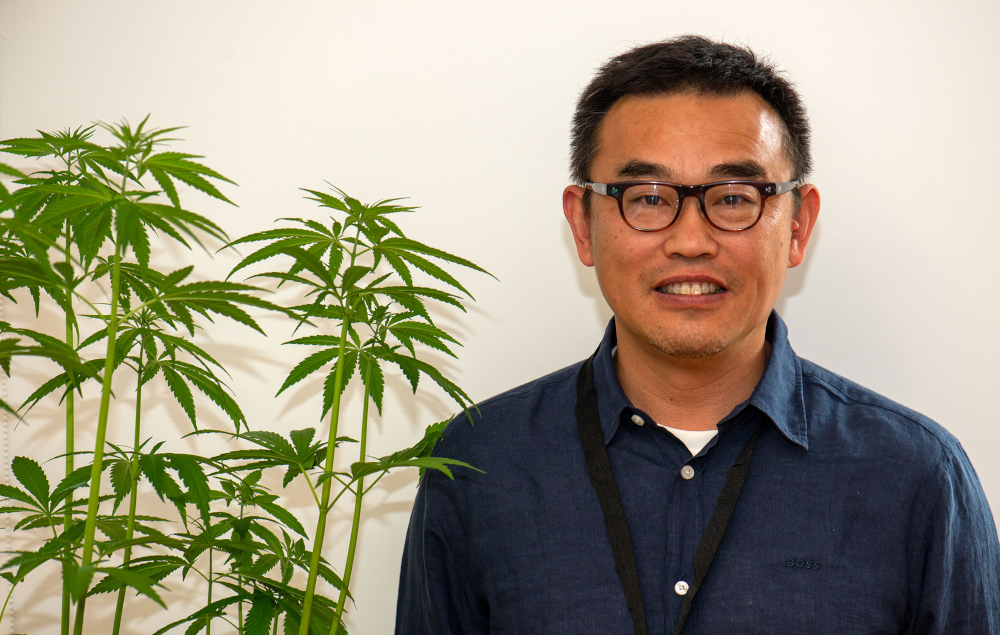
INTERVIEW: Hongliang Ding is founder and president of Hemp Fortex Industries, one of the world’s longest-established hemp textile companies. He founded the company in Qingdao, China, in 1999 and has more than 30 years of experience in hemp fiber processing and textile manufacturing. Hemp Fortex, which employs some 1,700 workers, supplies hemp fabrics, yarns and finished textile products to international apparel brands and has been a key player in developing cottonized hemp fiber and large-scale hemp textile supply chains.
HT: Thirty years is a long time in hemp. There must have been ups and downs. Where do you think the hemp-textile industry stands today?
Hongliang Ding: I think hemp has become one kind of regular natural material for the textile industry, just like linen. Hemp is still, I call it, the little brother of linen, but with new technology you can make almost the same, even better quality of yarn than linen. We’re not trying to replace linen, but we can share some of the same market.
My goal is to use cottonized hemp fiber to replace some share of cotton because cotton, I think a lot of people would agree, is not sustainable. Hemp can grow almost anywhere. The only big issue is processing the fiber. Technology-wise and cost-wise, it’s still a big challenge, so we’re trying to make hemp fiber as cheap as possible so it can take some share of cotton.
HT: Which textile products are the staples of your business?
HD: We process fiber to make yarn and fabric, and from that fabric we make many different products. Most of it goes into upholstery, shirts and normal textile applications, plus home textiles, garments and apparel. Anything linen can make, hemp can do the same work.
HT: What’s the biggest challenge facing China’s hemp-textile industry today?
HD: Surprisingly, labor in China is no longer cheap. That’s our biggest situation—we still have the best quality hemp fiber, but it’s getting more expensive to produce.
China used to have a labor advantage, but not anymore. I hope in the next five or ten years smart robots can do the work. As far as today, we’re not there yet. If the processing line can be operated mainly by computers, you can set it up anywhere, not necessarily in China.
HT: Where do you source fiber?
HD: We’ve been buying fiber from France, Germany, Turkey and Ukraine. In the future, we’d like to establish processing lines outside China, for example, in Europe or North America, because we’re also developing our own mechanical processing technology.
HT: Shipping straw from Europe or North America to China isn’t really sustainable from a business perspective, is it?
HD: You’re absolutely right. Ideally, if the processing line is set up close to the farms, that will be the best solution, but the cost of the machinery is still high.
HT: What about Australia? Does it have potential?
HD: I did some research. Actually, some Chinese companies bought a lot of land in Australia because they wanted to grow hemp there. But Australia has the same issue as North America and Europe. They don’t have the supply chain and they don’t have the know-how to make a decent textile fiber for the market. They’re still in the early stage of making textile hemp. Their biggest advantage is land because it’s so cheap.
HT: What about India as a potential supplier?
HD: I went to India to check the possibility of getting fiber, but I think they’re still in the early stage of industrial-scale farming.
HT: Where do you think overseas producers still fall short?
HD: Some companies are already using mechanical processing to make short fiber and low-count hemp yarn. That’s a good start, but the yarn is still quite coarse. It’s good for jeans and heavy fabrics, but we’re talking about luxury fabrics—high-end shirts, jackets, pants and underwear—which require much finer fiber.
HT: Which countries are best positioned to challenge China’s hemp-textile industry?
HD: So far I don’t think there’s any country that can really challenge China because China has a full supply chain and can make everything in one area.
HT: You must produce a lot of hurd. Who buys it?
HD: Yes, we do. Honestly, there isn’t much use for it. We have thousands and thousands of tons of hurd sitting in the field doing nothing. We’d be happy to exchange that for fiber if anybody needed a large amount.
It’s chopped, so it could be used for animal bedding. We have all the equipment to bale and package it, and actually we’re selling hurd to Australia. After the calculation, the hurd is probably cheaper landed there than producing it locally.
HT: We’ve heard that more hemp is being grown for food and grain in China. Is that creating competition for land?
HD: Yes. In China, we have a huge population but limited farmland, so there’s a kind of bottom-line or red-line policy. We need to maintain a certain amount of farmland to secure food. We’re a huge country, so we need that safety backup.
HT: Is hemp widely known as a food in China?
HD: No. It’s only used as food in certain areas and for oil. Some regions have been using hemp oil for centuries.